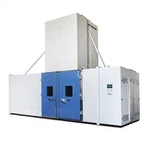
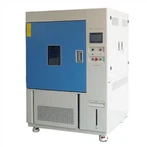
A salt fog chamber is a type of environmental test equipment designed to simulate the corrosive effects of saltwater exposure on materials, coatings, and components. It is primarily used in industries such as automotive, aerospace, electronics, and materials manufacturing to test the durability and resistance of products to corrosion under controlled conditions. For testing in accordance with ASTM B117 and ASTM G85, a salt fog chamber must meet specific design requirements to ensure reliable and accurate results.
Overview of ASTM B117 and ASTM G85
ASTM B117: This standard specifies the test method for the neutral salt spray (fog) test, which is used to evaluate the corrosion resistance of metallic coatings, protective coatings, and materials under a controlled, salt-laden environment. In this test, the sample is subjected to a fine mist of saltwater at a constant temperature and humidity for a specified period.
ASTM G85: This standard specifies the test methods for modified salt fog testing, which can simulate more aggressive and real-world environmental conditions by altering certain test parameters. One of the most common modifications is the cyclic salt fog test, which combines salt fog exposure with drying phases, alternate high humidity, or other environmental stress factors to accelerate corrosion and simulate real-world exposure to weathering and environmental elements.
Different test conditions of ASTM B117 and ASTM G85
ASTM B117 and ASTM G85 are both standard test methods used to evaluate the corrosion resistance of materials and coatings, but they focus on different aspects and have different procedures.
-
ASTM B117 test conditions
Temperature: The test is typically conducted at 35 °C.
Salt Solution: A 5% sodium chloride (NaCl) solution is used to generate the salt fog.
Specimen Positioning: Test specimens are positioned in the chamber at an angle, often around 15 to 30 degrees from vertical, to ensure uniform exposure to the salt mist.

-
ASTM G85 test conditions
A1. Acetic Acid-Salt Spray (Fog) Testing.
1. temperature in the saturator tower (bubble tower) is 47 +/-1°C
2. acetic acid salt spray fog chamber tempersture at 35 +/- 2 °C
A2. Cyclic Acidified Salt Fog Testing.
1. temperature in the saturator tower (bubble tower) is 57 +/-1 °C
2. salt spray chamber temperature at 49 +/-2 °C .
3. Make sure an inch or so of water is present in the bottom of the box
4. 6h repetitive cycles : 3/4-h spray; 2-h dry-air purge; 13/4-h soak at high relative humidity
5. purge
6. Collect the fog in a special continuous spray run of at least 16 hours periodically between test runs.
A3. Acidified Synthetic Sea Water (Fog) Testing
1. PH of salt solution between 2.8 ~ 3.0.
2. temperature in the saturator tower (bubble tower) is 47 +/-1 °C , if cabinet temperature is 35 °C .
temperature in the saturator tower (bubble tower) is 57 +/-1 °C , if cabinet temperature 49 °C .
3. An rich or so of water should always be present in the bottom of the box
4. Equip the cabinet with a timing device that can be used for the following cycle: 30 min spray followed by 90-min soak at above 98% relative humidity
A4. Salt/So2 Spray (Fog) Testing
1. temperature in the saturator tower (bubble tower) is 47 +/-1 °C
2. salt spray chamber temperature at 35 +/- 2 °C
3. So2 Gas - Equipment and materials required for addition of SO2 to cabinet are as follows
3.1. Cylinder of So2 gas.
3.2. Flowmeter capable of measuring So2 gas flow of 1 cm3/min.ft3 of cabinet volume (35 cm3/min.m3); also constructed of materials inert to So2 gas.
3.3. Timer
3.4. Two-way solenoid valve fabricated of materials inert to So2 gas.
3.5. Tubing and fittings for So2 line of materials inert to So2 gas.
4. PH of the collected solution shall range from 2.5 to 3.2.
5. So2 gas for 1h 4*a day (every 6h)
1/2-h salt spray, 1/2 So2. 2-h soak
A5. Dilute Electrolyte cyclic fog/dry testing
1. Wet/Dry Cycle - The cycle consists of 1-h fog followed by 1-h dry-off
2. During the fog period, the fog exposure is at ambient room temperature and conditions.
3. Dry-off temperature - the temperature throughout the exposure zone shall reach and
remain at 35 +/-1.5 °C within 3/4-h of switching from the fog period to the dry period
4. The dry-off is achieved by purging the chamber with fresh air, such that within 3/4-h
all visible moisture is dried off of the specimens.
LIB has suitable salt fog chambers to perform B117 and G85

LIB astm b117 salt fog chamber
Standard: ASTM B117
Temperature Range +10 ℃ ~ +90 ℃
Humidity Range 30% ~ 98% RH
Salt Fog Deposition 1~2ml / 80cm2 · h
LIB aSTM G85 salt fog chamber
Standard: ASTM G85
Temperature Range +10 ℃ ~ +90 ℃
Humidity Range 30% ~ 98% RH
Salt Fog Deposition 1~2ml / 80cm2 · h
SO2 Gas Control Control and display volume of SO2 gas

Choose LIB, you will get:
-
Various size to suit different samples, from 100L to 3000L
- A variety of customized features to meet your testing needs
- Fast response: LIB team will send you specs and price quote once get you inquiry.