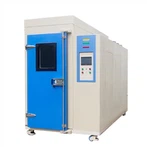
Environmental testing is becoming increasingly important as products are expected to operate reliably in a wide range of conditions. From electronic sensors and automotive modules to aerospace components and medical devices, manufacturers need accurate ways to evaluate how products perform when exposed to heat, cold, humidity, and temperature fluctuations.
The LIB Small Thermal Chamber provides a compact yet powerful solution for environmental simulation. Designed for laboratories, R&D departments, quality control centers, and production facilities, it delivers precise temperature and humidity control while occupying minimal floor space. This article explains the primary uses of a Small Thermal Chamber, how it supports international testing standards, and why many leading manufacturers choose LIB chambers for daily reliability testing.
What is a Small Thermal Chamber Used For?
1. Environmental Reliability Testing
One of the most common uses of a Small Thermal Chamber is environmental reliability testing. Products are exposed to controlled temperature and humidity conditions to evaluate long-term durability and operational stability before entering the market.
The chamber supports numerous IEC 60068 environmental testing methods, including IEC 60068-2-1 Cold Test, IEC 60068-2-2 Dry Heat Test, IEC 60068-2-14 Temperature Change Test, IEC 60068-2-30 Damp Heat Cyclic Test, and IEC 60068-2-78 Damp Heat Steady State Test. Typical test conditions include -40°C cold storage testing, +85°C high-temperature operation testing, 85°C/85% RH damp heat aging, and temperature cycling between -40°C and +85°C. These tests help manufacturers identify potential product failures before mass production.
Industries including electronics, telecommunications, consumer electronics, automotive electronics, and industrial automation rely on these testing methods to verify product reliability under real-world environmental conditions.
2. Product Qualification and Standards Compliance
A Small Thermal Chamber is widely used to verify compliance with international product qualification standards. Manufacturers often need environmental test data before products can receive certifications or enter regulated markets.
The chamber supports testing according to IEC 60068, MIL-STD-810, ISO 16750, JESD22, ASTM D4332, and GB/T 2423 standards. For example, automotive electronic modules are frequently tested according to ISO 16750 temperature cycling requirements. Semiconductor components commonly undergo JESD22-A104 temperature cycling tests and JESD22-A101 humidity testing. Aerospace suppliers often conduct environmental qualification according to MIL-STD-810 procedures.
By performing these tests inside a controlled chamber environment, manufacturers can generate repeatable and traceable data required for certification, customer approval, and quality audits.
3. Accelerated Life Testing and Product Development
Small Thermal Chambers are also valuable tools during product development. Engineers use them to accelerate environmental stress and identify weaknesses before finalizing designs.
Typical accelerated testing conditions include continuous operation at 70°C, storage testing at -20°C, thermal cycling from -40°C to +85°C, humidity aging at 95% RH, and long-term exposure testing at 60°C and 90% RH. By compressing years of environmental exposure into weeks or months of laboratory testing, manufacturers can shorten development cycles and improve product quality.
This capability is particularly important for batteries, sensors, connectors, PCB assemblies, LED lighting systems, and medical devices where environmental reliability directly affects product performance and customer satisfaction.
Why Apple's Suppliers Chose Multiple LIB TH-80 Small Thermal Chambers
Several suppliers serving major global electronics brands have selected multiple LIB TH-80 Small Thermal Chambers for product performance verification and environmental qualification testing.
One important reason is convenience. The 80 L chamber fits directly beside engineering workstations, allowing operators to quickly load and remove samples without transporting products across large laboratories. This significantly improves testing efficiency during rapid product development cycles.
Another advantage is measurement accuracy. The chamber provides temperature stability of ±0.5°C and humidity control within ±2.5% RH. Combined with PT100 Class A sensors and intelligent PID control, this ensures repeatable test conditions throughout long-duration qualification programs.
Safety is also a key consideration. The TH-80 incorporates over-temperature protection, refrigerant high-pressure protection, leakage protection, humidifier dry-burn protection, water shortage protection, and over-current protection. These features help protect both test samples and laboratory personnel during continuous operation.
In addition, the chamber complies with major international safety and quality requirements, including CE requirements, IEC environmental testing standards, CSA-related electrical safety practices, and ISO-based quality systems. Customers appreciate the balance between performance, reliability, operating cost, and long-term maintenance requirements.
For many electronics manufacturers, the compact footprint, high accuracy, operational safety, and competitive cost of ownership make the TH-80 an attractive alternative to larger environmental chambers.
LIB Small Thermal Chamber vs Fast Change Small Thermal Chamber
Different applications require different temperature transition speeds. The following comparison helps users choose the most suitable chamber.
|
|
|
|
|---|---|---|
| Temperature Range | -20°C to +150°C / -40°C to +150°C / -70°C to +150°C | -70°C to +180°C |
| Humidity Range | 20% RH to 98% RH | 20% RH to 98% RH |
| Heating Rate | 3°C/min | 5°C/min, 10°C/min, 15°C/min, 20°C/min |
| Cooling Rate | 1°C/min | 5°C/min, 10°C/min, 15°C/min, 20°C/min |
| Chamber Volume | 50L, 80L | Customized |
| Power Consumption | Lower | Higher |
| Operating Cost | Lower | Higher |
| Best For | Reliability testing, aging tests, qualification testing | Highly accelerated testing, ESS, rapid thermal stress screening |
| Typical Standards | IEC 60068, ISO 16750, JESD22 | IEC 60068-2-14, MIL-STD-810, JESD22-A104 |
| Investment Cost | Economical | Premium |


How to Choose?
Choose the Small Thermal Chamber if your primary goal is routine reliability testing, damp heat testing, product qualification, storage testing, and environmental simulation with lower operating costs.
Choose the Fast Change Small Thermal Chamber if you require aggressive temperature transitions, accelerated stress screening, thermal fatigue evaluation, or rapid product development programs where testing speed is critical.
LIB Best-Selling Thermal Chambers

Benchtop Thermal Chamber
Space-Saving Laboratory Design, Precise Temperature and Humidity Control

Reach-In Thermal Chamber
Versatile Testing for Multiple Industries, Stable and Uniform Environmental Conditions

Drive In Thermal Chamber
Easy Access for Large Test Specimens, High-Capacity Environmental Simulation

Thermal Oven
Rapid Heating Performance, Reliable Long-Term Thermal Aging Tests

Fast Change Rate Thermal Chamber
Up to 20°C/min Temperature Ramp Rates, Accelerated Product Reliability Validation

Temperature Humidity Vibration Chamber
Combined Climatic and Vibration Testing, Reduced Testing Time and Improved Correlation
FAQs on the Small Thermal Chamber
Q1: How long is the warranty period?
LIB provides a 3-year warranty and lifetime technical support. During the warranty period, replacement parts and technical assistance are provided according to warranty terms.
Q2: Can the chamber be customized?
Yes. Chamber size, temperature range, cable ports, sample fixtures, shelves, communication interfaces, and controller functions can all be customized according to testing requirements.
Q3: How is the equipment shipped internationally?
The chamber is packed in reinforced export-grade wooden crates with internal protection. Detailed installation guidance is provided before shipment, and global transportation can be arranged by sea, air, rail, or truck depending on destination requirements.
Q4: What happens if replacement parts are needed?
LIB maintains global spare-parts inventory. Most standard replacement parts can be shipped within 7–15 days. Technical engineers provide remote installation and troubleshooting support throughout the service life of the equipment.
Q5: Does LIB provide installation and training?
Yes. LIB provides operation manuals, video guidance, remote commissioning, and online training. On-site service and calibration support can also be arranged for large projects and laboratory installations.
Whether you are performing IEC 60068 qualification testing, automotive reliability verification, semiconductor environmental screening, or product development validation, the LIB Small Thermal Chamber provides precise control, reliable performance, and long-term durability in a compact footprint.
Contact LIB Industry today to discuss your testing requirements and discover how the Small Thermal Chamber can help accelerate product qualification, improve reliability, and reduce development time.