
Modern products must survive extreme climates. Automotive control units face −40 °C winters and 85 °C engine heat.  Batteries operate in 95 % RH tropical environments. Solar modules endure long-term damp heat at 85 °C/85 % RH for 1,000 hours. Without controlled environmental simulation, hidden failures such as corrosion, seal leakage, insulation breakdown, and solder cracking remain undetected until products reach the market.
Recently, customer Keyhan shared his feedback after installing and running the chamber in his lab: "We have been using the chamber since last week. It is overall good so far. I will keep you updated." From installation to operation, the chamber demonstrated stable temperature ramping, consistent humidity control, and smooth system performance. For laboratories, early operational stability is critical - it means accurate data, fewer interruptions, and confidence in long-duration tests such as 85 °C/85 % RH damp heat or thermal cycling from −40 °C to +85 °C. Positive real-user feedback confirms that reliable environmental simulation starts with precise control and dependable hardware.
LIB Temperature and Humidity Chamber recreates these conditions in a precise and repeatable way. With temperature control from −70 °C to +150 °C, humidity range from 20 % to 98 % RH, and ±0.5 °C fluctuation accuracy, it supports automotive, battery, photovoltaic, and defense testing under international standards including IEC 60068-2-30, IEC 61215, SAE J2334, and VW 80000.
Overview of the Temperature and Humidity Chamber
Origin and Purpose
Environmental simulation began in the aerospace and military industries, where equipment had to perform reliably under extreme climate stress. Today, industries such as automotive, energy storage, electronics, and lighting rely on temperature and humidity chambers for durability validation and certification.
Key Benefits
• Detect early material degradation before mass production
• Reduce warranty failure rates
• Meet international compliance standards
• Improve product lifespan by 20–30 % through design optimization
Standards Compliance
LIB chambers comply with:
1. Battery Testing Standards:
UL 2580, UL 2271, IEC 62660-2, UL 1642, UL 1973, SAE J2929, SAE J2464, IEC 61960, IEC 62133, UL 2054
2. Photovoltaic Module Standard:
IEC 61215
3. Automotive Standards:
SAE J2334, VW 80000
4. Luminaire Material Standard:
IEC 62717
Temperature deviation is controlled within ±2.0 °C.
Humidity accuracy reaches ±2.5 % RH.
Heating rate: 3 °C/min (optional up to 20 °C/min).
Cooling rate: 1 °C/min.
High-precision PT100 Class A sensors provide ±0.001 °C resolution.
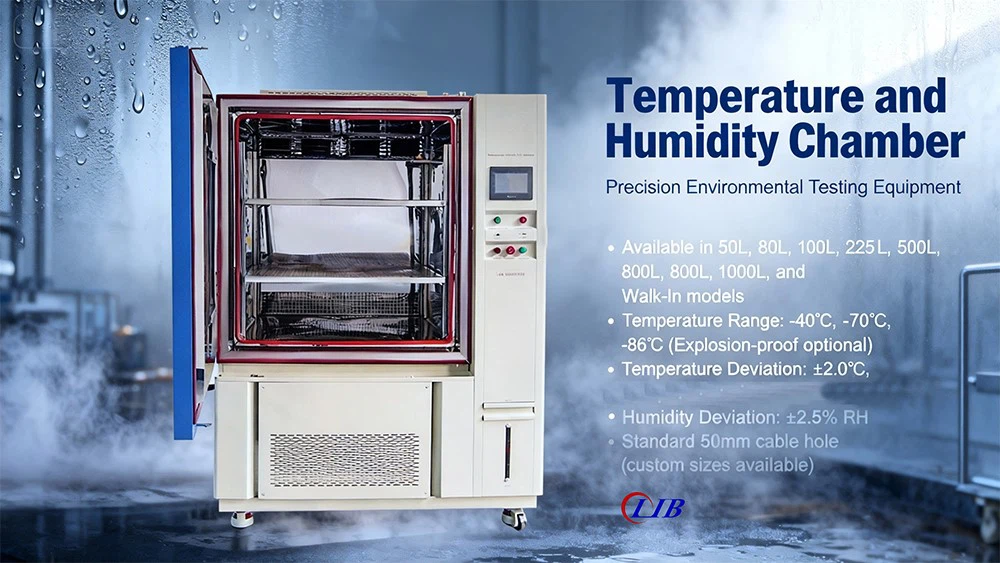
Temperature Humidity Chambers for aging test
Automotive Testing Procedure in a Temperature and Humidity Chamber
Here we use VW 80000 as an example.
Typical Damp Heat Cycle Example
|
|
Name | Temperature Humidity Chamber | ||||
|
Model |
TH-100 |
|||||
|
Internal dimension (mm) |
400*500*500 |
|||||
|
Overall dimension (mm) |
860*1050*1620 |
|||||
|
Capacity |
100L |
|||||
|
Temperature range |
-20℃ ~+150 ℃ |
|||||
|
Low type |
A: -40℃ B:-70℃ C -86℃ |
|||||
|
Humidity Range |
20%-98%RH |
|||||
|
Temperature deviation |
± 2.0 ℃ |
|||||
|
Heating rate |
3 ℃ / min |
|||||
|
Cooling rate |
1 ℃ / min |
|||||
|
Controller |
Programmable color LCD touch screen controller, Multi-language interface, Ethernet , USB |
|||||
|
Refrigerant |
R404A, R23 |
|||||
|
Exterior material |
Steel Plate with protective coating |
|||||
|
Interior material |
SUS304 stainless steel |
|||||
|
Standard configuration |
1 Cable hole (Φ 50) with plug; 2 shelves |
|||||
|
Timing Function |
0.1~999.9 (S,M,H) settable |
|||||

|
|
|
|
|
|
| Robust Workroom | Cable Hole | Temperature and Humidity Sensor | PID controller |


Step 1 – Heating Phase
Raise temperature from 25 °C to 80 °C at 3 °C/min.
LIB Advantage: PID intelligent control prevents overshoot and stabilizes within ±0.5 °C.
Step 2 – Humidity Rise
Increase humidity to 95 % RH within 60 minutes.
LIB Advantage: Closed-loop steam humidification ensures uniform moisture distribution without condensation dripping.
Step 3 – High Temperature & High Humidity Soak
Maintain 80 °C / 95 % RH for 16 hours.
LIB Advantage: Dual centrifugal fans create laminar airflow, eliminating hot and wet spots.
Step 4 – Cooling Phase
Reduce temperature to −40 °C.
LIB Advantage: Balanced refrigeration system maintains stable ramping and protects sensitive automotive electronics.
Step 5 – Low Temperature Hold
Hold −40 °C for 2 hours.
LIB Advantage: SUS304 stainless steel interior resists thermal stress and prevents corrosion during condensation freeze cycles.
This cycle may repeat 5–10 times depending on component requirements. Such testing identifies PCB corrosion, connector oxidation, and housing deformation before vehicle integration.
How to Maintain a Temperature and Humidity Chamber
Routine maintenance ensures long-term stability and reduces downtime.
1. Daily Inspection
• Check water level in humidification tank
• Inspect door sealing gasket
• Verify sensor readings
2. Weekly Maintenance
• Clean air circulation filters
• Drain condensate water
• Inspect electrical wiring terminals
3. Monthly Verification
• Calibrate PT100 sensors
• Inspect refrigeration pressure
• Test safety interlocks (over-temperature, leakage protection, phase monitoring)
LIB chambers feature:
Interior: SUS304 stainless steel
Exterior: 4 mm A3 powder-coated steel
Noise level: below 65 dB(A)
Safety systems: grounding protection, over-temperature shutdown, low-water alarm
Routine checks take less than 15 minutes and significantly extend equipment lifespan beyond 10 years.
FAQs on the Temperature and Humidity Chamber
Q1: What tests can be performed?
Thermal cycling, damp heat (85 °C/85 % RH), humidity freeze, high-temperature aging, low-temperature storage, and shelf-life testing.
Q2: How accurate is the chamber?
Temperature fluctuation ±0.5 °C.
Humidity accuracy ±2.5 % RH.
Q3: Can it support battery certification?
Yes. It complies with UL 2580, IEC 62660-2, and SAE J2464 environmental requirements.
Q4: Is remote monitoring available?
Yes. Ethernet and USB connectivity allow real-time logging and CSV export.
Q5: What industries use this chamber?
Automotive, photovoltaic (IEC 61215), lighting (IEC 62717), defense equipment, and energy storage systems.
Download LIB's technical whitepaper to learn step-by-step setup procedures, validation methods, and real-world automotive case studies.
Everything you need to execute accurate environmental simulation testing in one practical guide.
Contact LIB Industry to upgrade your environmental testing system today.


