
In today's competitive industries, product reliability is no longer optional. Batteries must pass safety validation before shipment. Automotive components must survive years of heat, cold, and humidity. Photovoltaic modules must endure long-term damp-heat exposure. If environmental conditions are not precisely controlled, test data becomes unreliable-and certification can be delayed.
LIB temperature and humidity test chamber is designed to provide stable, repeatable, and standards-compliant environmental simulation from –70 °C to +150 °C and 20 % to 98 % RH. With ±0.5 °C temperature fluctuation and ±2.5 % RH humidity accuracy, it supports global regulatory standards while delivering consistent laboratory performance.
1. What Tests Does a Temperature and Humidity Test Chamber Commonly Perform?
Battery reliability and safety tests are one of the most important applications.
Standards such as UL 2580, UL 2271, UL 1642, UL 1973, UL 2054, IEC 62660-2, IEC 61960, IEC 62133, SAE J2929, SAE J2464, and IEC 60068-2-30 require temperature cycling, high-temperature storage, damp heat exposure, and humidity aging. For example, IEC 60068-2-30 specifies cyclic damp heat tests, typically at 40 °C and 93 % RH. UL standards often require high-temperature storage at 70 °C–130 °C to evaluate thermal stability.
Photovoltaic module testing relies heavily on damp-heat performance.
Under IEC 61215, PV modules must withstand 85 °C / 85 % RH for 1000 hours. This "85/85" test verifies encapsulation durability and resistance to moisture ingress. A chamber must maintain long-term stability without temperature or humidity drift.
Automotive component validation demands thermal cycling and humidity endurance.
Standards such as SAE J2334, VW 80000, and ISO 16750 require temperature cycling from sub-zero conditions (–40 °C) to high heat (+85 °C or higher). ISO 16750 includes combined temperature-humidity testing to simulate under-hood and cabin environments.
Electronics and electrical devices must pass environmental stress screening (ESS).
According to IEC 60068, components undergo high-temperature tests, low-temperature tests, humidity steady-state tests, and rapid thermal transitions. Typical heating rates are 3 °C/min and cooling rates 1 °C/min to accelerate defect detection.
Lighting and material durability testing verifies long-term stability.
Under IEC 62717, luminaires are exposed to high temperature and humidity to assess material degradation. Plastics, coatings, and insulation materials are often tested at 60 °C–90 °C with controlled humidity to evaluate aging and mechanical retention.
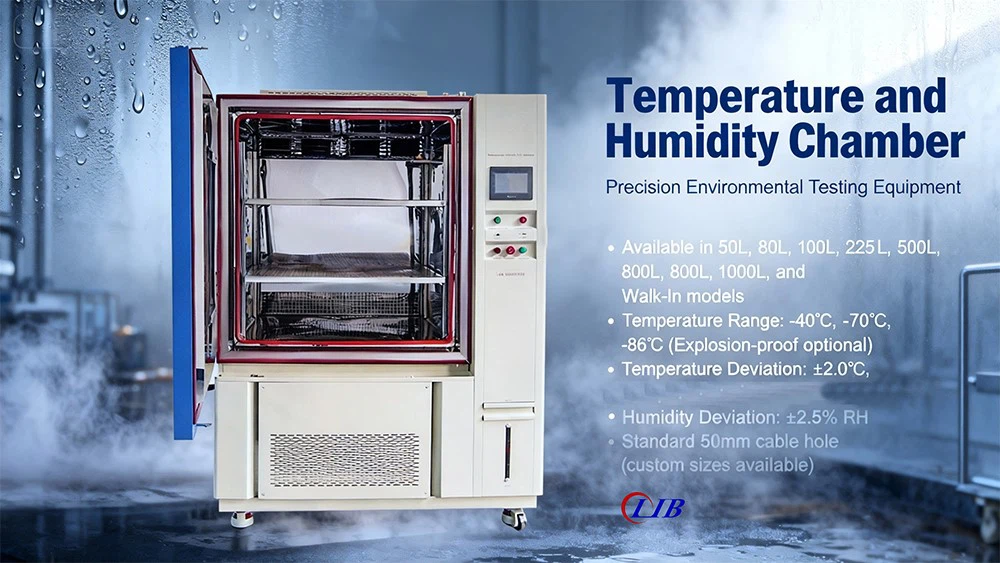
Temperature Humidity Chambers for aging test
2. How Does LIB Ensure Temperature and Humidity Accuracy?
|
|
Name | Temperature Humidity Chamber | ||||
|
Model |
TH-100 |
|||||
|
Internal dimension (mm) |
400*500*500 |
|||||
|
Overall dimension (mm) |
860*1050*1620 |
|||||
|
Capacity |
100L |
|||||
|
Temperature range |
-20℃ ~+150 ℃ |
|||||
|
Low type |
A: -40℃ B:-70℃ C -86℃ |
|||||
|
Humidity Range |
20%-98%RH |
|||||
|
Temperature deviation |
± 2.0 ℃ |
|||||
|
Heating rate |
3 ℃ / min |
|||||
|
Cooling rate |
1 ℃ / min |
|||||
|
Controller |
Programmable color LCD touch screen controller, Multi-language interface, Ethernet , USB |
|||||
|
Refrigerant |
R404A, R23 |
|||||
|
Exterior material |
Steel Plate with protective coating |
|||||
|
Interior material |
SUS304 stainless steel |
|||||
|
Standard configuration |
1 Cable hole (Φ 50) with plug; 2 shelves |
|||||
|
Timing Function |
0.1~999.9 (S,M,H) settable |
|||||

Accurate sensing is the foundation of environmental reliability.
LIB chambers use PT100 Class A temperature sensors with ±0.001 °C resolution. Humidity is controlled within ±2.5 % RH across a 20 %–98 % RH range. Temperature fluctuation is limited to ±0.5 °C, with maximum deviation within ±2.0 °C.
Factory calibration follows a strict 9-point verification method.
After assembly, nine calibrated temperature probes are evenly distributed inside the working chamber. The average value is compared with the setpoint. If deviation is detected, hardware parameters are adjusted to ensure uniformity within ±1.5 °C across the workspace.
Humidity calibration is based on dry-bulb and wet-bulb comparison.
Technicians record dry and wet bulb temperatures, calculate relative humidity values, and compare them with standard reference tables. Any deviation is corrected through system parameter adjustment, ensuring humidity accuracy before shipment.
Advanced PID control guarantees stable long-term performance.
The PID controller continuously adjusts heating, cooling, and humidification systems to prevent overshoot and drift. This ensures stable operation during 1000-hour damp heat tests or multi-step temperature cycling programs.
3. Advantages of LIB Temperature and Humidity Test Chamber
|
|
|
|
|
|
| Robust Workroom | Cable Hole | Temperature and Humidity Sensor | PID controller |


Flexible configuration meets different laboratory sizes and applications.
Chamber volumes, height, width, and internal layout can be customized. Adjustable sample shelves, reinforced racks, and optional sliding rails support heavy automotive components or lightweight electronic boards.
Custom design options expand testing capabilities.
Options include double doors, airflow control systems, spray systems, condensation prevention modules, and customized cable holes (size, shape, and quantity). Ramp rates can be customized up to 20 °C/min for advanced testing.
Operational efficiency improves laboratory productivity.
A 7-inch color touchscreen supports 120 programs with 100 steps each. Ethernet and USB connectivity enable real-time monitoring and automatic report export in CSV or PDF format. Noise level remains below 65 dB(A), suitable for laboratory environments.
Durable structure ensures long service life.
The interior is made of SUS304 stainless steel for corrosion resistance. The exterior uses powder-coated A3 steel with a reinforced frame. Safety protections include over-temperature shutdown, leakage current protection, grounding, and phase monitoring.
4. FAQs on the LIB Temperature and Humidity Test Chamber
Q1: What temperature range does the chamber support?
A1: Standard range is –40 °C to +150 °C, with optional extension to –70 °C. Humidity control ranges from 20 % to 98 % RH.
Q2: How stable is the chamber during long-term testing?
A2: Temperature fluctuation is ±0.5 °C, humidity accuracy ±2.5 % RH, suitable for 1000-hour damp heat tests such as IEC 61215.
Q3: Can one computer control multiple chambers?
A3: Yes. Ethernet connection allows centralized PC control of multiple chambers simultaneously.
Q4: What maintenance is required?
A4: Routine maintenance includes filter replacement, water refilling, and periodic sensor verification. Most procedures take only minutes.
Reliable environmental simulation is essential for product certification and long-term durability validation. LIB temperature and humidity test chamber provides precise control, standards compliance, and customizable solutions for batteries, automotive parts, electronics, photovoltaic modules, and more.
Contact LIB Industry to design a temperature and humidity testing solution tailored to your application.


