
When manufacturers want to understand how metal parts, coatings, fasteners, or electronic components behave in harsh environments, salt spray testing is one of the most direct and reliable methods. Corrosion failure can happen within months in outdoor applications, but in a salt spray chamber, the same effect can be simulated in hours or days. This makes the method a fast, repeatable, and low-cost way to evaluate durability before a product reaches the market.
LIB Salt Spray Corrosion Test Chamber provides continuous, stable, and standardized salt fog conditions to help users meet strict international test requirements. By recreating a controlled corrosive environment defined by recognized testing standards such as ASTM B117 and ISO 9227, the chamber supports performance evaluation for automotive parts, coated metals, connectors, marine hardware, and industrial components.
What Is the Function of the Salt Spray Corrosion Test Chamber?
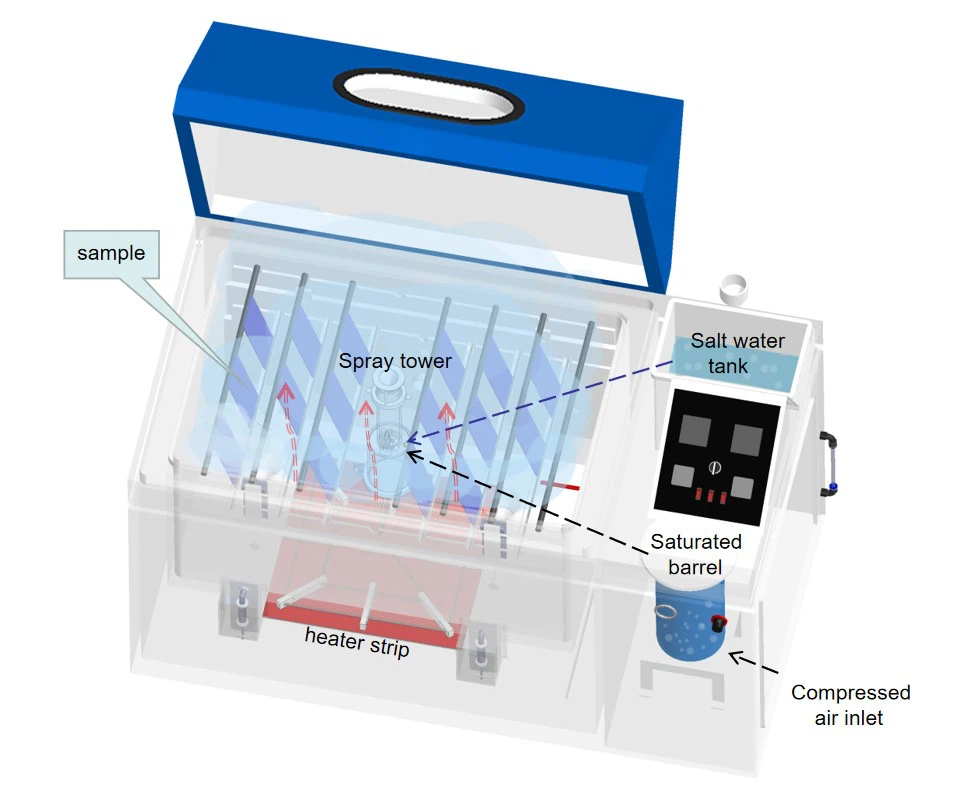
The primary function of a salt spray corrosion test chamber is to simulate a highly accelerated corrosive environment. This environment is created by atomizing saltwater and distributing it uniformly throughout a sealed chamber. The chamber maintains a constant temperature-typically 35 °C for neutral salt spray tests-to support consistent and repeatable corrosion conditions.
Salt spray chambers are used because corrosion is influenced by humidity, salt concentration, pH levels, and exposure duration. These factors change constantly in natural environments, making outdoor corrosion unpredictable. By contrast, a dedicated chamber controls the salt concentration (usually 5 % NaCl), fog fallout rate (1–2 mL/80 cm² per hour), chamber temperature, and air pressure, allowing users to compare results between coatings, materials, or suppliers.
Salt spray testing also helps manufacturers estimate product life expectancy. Instead of waiting months for a rust pattern to develop in real-world conditions, engineers can observe corrosion responses in 24–96 hours. This makes it especially valuable for screening surface treatments like electroplating, painting, powder coating, anodizing, or galvanizing.
In industries such as automotive, aerospace, home appliances, and marine construction, salt spray chambers play a key role in quality control. They ensure that coatings resist blistering, pitting, peeling, or rusting before components are approved for production.
| Salt Spray Corrosion Test Chamber For Corrosion Testing | |
|
|
1. Advanced Salt Spray Chamber ASTM B117 2. ISO 11997-1 Salt Test Chamber 3. Effective Salt Spray Fog Test Chamber 5. JIS Z 2371 Salt Spray Test Chamber 6. ASTM G85 Salt And SO2 Spray Test Chamber |

Salt Spray Method of Corrosion Testing Using a Salt Spray Corrosion Test Chamber
The salt spray method follows internationally recognized standards that define the test setup, salt solution, environmental conditions, and evaluation criteria. The most widely applied standards include:
Primary Standards for Salt Spray Testing
- ASTM B117 (neutral salt spray method; defines salt concentration, pH 6.5–7.2, temperature 35 °C, atomization methods, fog collection rate)
- ISO 9227 (international standard for NSS, AASS, and CASS tests; defines corrosion conditions and rating requirements)
- ASTM G85 (modified salt spray, including cyclic corrosive environments)
Additional Applicable Standards
EN ISO 7253, EN 60068-2-52, BS 3900, ISO 20340(英标/欧标)
DIN 50021(德标)
ASTM D5894, ASTM B368, SAE J2334(美标)
NFX 41-002, CT OI OIA(法标)
JIS Z 2371, JIS H 8502(日标)
Corporate standards: Ford, GM, Toyota, Honda, Nissan, Renault, Peugeot, Jaguar, Volvo, VW, Audi, BMW
How the Method Works
The chamber atomizes a 5 % sodium chloride solution using clean compressed air, forming a dense salt fog. This fog settles onto metal surfaces, promoting accelerated corrosion. Test duration ranges from 24–1000 hours depending on the material and standard.
Key controlled parameters include:
- Temperature: 35 °C ± 1 °C
- Salt concentration: 5 % NaCl (or per specific test requirement)
- Fog fallout rate: 1–2 mL per 80 cm² per hour
- pH level: 6.5–7.2 (ASTM B117)
These conditions ensure every sample receives uniform exposure, allowing engineers to compare corrosion resistance across coatings, metals, or manufacturing batches.
| Name | Salt Spray Corrosion Test Chamber | ||
|
Model |
S-150 |
S-250 |
S-750 |
|
Internal dimensions (mm) |
470*590*400 |
640*1000*500 |
750*1100*500 |
|
Overall dimensions (mm) |
620*1400*1050 |
810*1800*1180 |
920*1900*1200 |
|
Temp. Range |
Ambient ~ +60 degree |
||
|
Temp. Fluctuation |
± 0.5 ℃ |
||
|
Temp. Deviation |
± 2.0℃ |
||
|
Humidity Range |
95 % ~ 98 % RH |
||
|
Salt Fog Deposition |
1~2ml / 80cm2 · h |
||
|
Spray Type |
Continuous / Periodic |
||
|
Heating Element |
Nichrome heater |
||
|
Salt Fog Collected |
Fog collector and fog measure cylinder |
||
|
Controller |
PID controller |
||
|
Material |
Glass fiber reinforced plastics |
||
|
Standard Configuration |
8 round bars and 7 V-shaped grooves |
||
|
Power |
380V 50Hz |
||
|
Environmental Conditional |
5 ℃~+35 ℃ ≤85% RH |
||
Procedure for Testing Metal Corrosion Resistance Using the LIB Salt Spray Corrosion Test Chamber
Electronics, automotive parts, metal housings, and connectors often face moisture, salt, and temperature changes that can cause rust or coating damage. Salt spray testing is used to verify whether a product meets durability expectations before mass production. The test helps evaluate coating adhesion, surface quality, protective layers, and the presence of early corrosion defects.
|
Classify |
Type 1 |
Type 2 |
Type 3 |
|
Name |
Salt Spray Test Chamber |
Salt Cyclic Corrosion Test Chamber |
Salt and So2 Corrosion Test Chamber |
|
|
|
|
|
|
Model |
S-150, S-250, S-750 S-010, S-016, S-020, |
SC-010, SC-016, SC-020 |
SSC-010, SSC-016, SSC-020 |
|
Test Standard |
ASTM B117; ISO9227 (NSS, NASS, CASS ); |
ASTM B117; ISO9227; IEC60068-2-52; |
ASTM B117; ISO9227; IEC60068-2-52; ASTM G85 (A4); |
|
Function |
Salt fog spray; Temp (Ambient ~+60℃) |
Salt fog Spray; Temp (+10℃ ~+90℃); Humid (30% ~98%RH); |
Salt fog Spray; Temp (+10℃ ~+90℃); Humid (30% ~98%RH); So2 gas; |


 |
 |
Step 1: Prepare the Sample
Clean the surface to remove oil, fingerprints, or debris. Measure coating thickness and record initial conditions.
LIB Advantage: Automatic logging allows users to store pre-test data and match it with post-test evaluations.
Step 2: Prepare the Salt Solution
Mix 5 % NaCl solution using deionized water and adjust pH to 6.5–7.2.
LIB Advantage: Built-in pH monitoring and corrosion-resistant tanks ensure stable and consistent solution quality.
Step 3: Set Chamber Parameters
Set temperature to 35 °C, adjust air pressure, and check fog collection rate until it reaches 1–2 mL/80 cm² per hour.
LIB Advantage: High-accuracy sensors and uniform atomization guarantee consistent fog distribution across all sample areas.
Step 4: Start the Exposure Test
Place samples at a 15–30° angle, ensuring no dripping from one sample to another, and run the test for the required number of hours.
LIB Advantage: Precise airflow routing minimizes dead zones and supports multi-sample testing without affecting uniformity.
Step 5: Inspect and Record Results
After testing, rinse samples with deionized water, dry them at room temperature, and compare results with the required rating charts (e.g., ISO 9227 rating system).
LIB Advantage: Data export through USB or Ethernet simplifies reporting for QA teams and third-party audits.
|
|
|
| Corrosion-Resisitant Workroom | Modular grooves are used for holding samples |


|
salt spray tower |
cylinder |
spray collector |


Guidelines for Maintaining the Salt Spray Corrosion Test Chamber
Routine maintenance ensures stable operation and prevents contamination that could affect test accuracy.
Clean the nozzles and fog distributor weekly to prevent salt blockage.
Replace saltwater solution regularly to maintain consistent concentration.
Inspect air filters and drainage lines to ensure smooth airflow and water discharge.
Check sensors and temperature controllers to verify accuracy.
Rinse the chamber interior with clean water after every test cycle to prevent salt buildup.
By maintaining these components, the chamber delivers stable fog output, accurate temperature control, and long-term operational reliability.
Any customization can be made. LIB offers a 3-year warranty and lifetime service. Any issues that cannot be resolved during the warranty period will be replaced free of charge. 24/7 English-speaking after-sales team. Fast shipping within 7-15 days.
Contact LIB Industry to learn more about salt spray testing solutions and receive a complete technical guide for corrosion evaluation.


