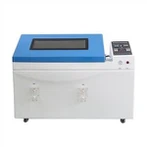
Salt spray testing is a widely recognized method for assessing how metals, coatings, and electronic components resist corrosion under accelerated conditions. When products face harsh outdoor environments, corrosion can develop within months or even weeks. Using a salt spray chamber, the same effects are simulated in a matter of hours or days. This makes salt spray testing a fast, reliable, and cost-effective approach for evaluating product durability before release to the market.
ASTM B117 is the standard that defines the parameters for neutral salt spray (NSS) testing. LIB Salt Spray Tester Conforming to ASTM B117 provides controlled conditions to simulate corrosive exposure, ensuring reproducible results. Manufacturers can evaluate coatings, metals, and surface treatments accurately, benchmark different materials, and make informed decisions about product quality and life expectancy.
1. Requirements of ASTM B117 for Salt Spray Test
ASTM B117 sets specific requirements for performing neutral salt spray tests to ensure consistency and comparability across laboratories and products. First, the standard specifies the composition of the salt solution: 5 ± 1 parts by mass of sodium chloride dissolved in 95 parts of Type IV deionized water (per ASTM D1193). This solution provides a neutral pH environment (6.5–7.2), which is critical for evaluating general corrosion resistance without introducing additional chemical accelerants.
Temperature control is another core requirement. The exposure zone in the salt spray chamber should maintain 35 ± 1 °C for NSS tests. This range ensures that corrosion progresses uniformly across all samples. Deviations beyond ±2 °C may affect results, so precise instrumentation and control systems are essential.
Fog deposition rate is also strictly defined. In the horizontal collection area, the salt fog must settle at 1.0–2.0 mL per 80 cm² per hour. Maintaining this rate guarantees that each sample receives consistent exposure, allowing meaningful comparisons between coatings, metals, or suppliers.
Finally, ASTM B117 emphasizes uniformity in testing conditions. The standard does not require exact replication of outdoor environments but ensures that the chamber produces repeatable, controlled corrosion stress. By standardizing solution composition, temperature, and fog deposition, ASTM B117 enables reliable accelerated testing across industries worldwide.
| Requirement | Details | Purpose |
|---|---|---|
| Salt Solution Composition | 5 ± 1 parts by mass NaCl + 95 parts Type IV deionized water (per ASTM D1193) | Provides a neutral pH environment (6.5–7.2) to evaluate general corrosion resistance without additional accelerants |
| pH Range | 6.5 – 7.2 | Ensures neutral testing conditions for consistent corrosion evaluation |
| Temperature Control | Exposure zone at 35 ± 1 °C | Guarantees uniform corrosion progression across all samples |
| Temperature Deviation | ± 2 °C maximum | Prevents skewed results due to uneven heating |
| Fog Deposition Rate | 1.0 – 2.0 mL per 80 cm² per hour in horizontal collection area | Ensures uniform salt fog exposure for reproducible comparisons between coatings, metals, or suppliers |
| Testing Uniformity | Controlled, repeatable corrosion stress | Standardizes accelerated testing conditions without replicating exact outdoor environments |
2. Applications of Salt Spray Tester Conforming to ASTM B117

- Automotive Industry: Paint coatings, interior trim, headlights, motors, engines, sealing strips, dashboards, batteries.
- Aerospace Industry:Aircraft parts, drones, precision aerospace components.
- Electronics & Electrical Products:Mobile phones, computers, robots, PCB boards, connectors.
- Metal Components & Hardware:Fasteners, valves, stainless steel parts, hinges.
- Energy & Renewable Sector:Solar panels, PV modules, EV batteries, wind/solar/hydro equipment.
- Marine & Oil Equipment:Ship components, drill bits, petroleum machinery.
- Consumer & Packaging Products:Bottles, containers, films, labels, daily-use plastic products.
- Coatings & Surface Treatments:Electroplating, powder coating, anodizing, galvanizing, painting.
- Construction & Industrial Materials: Cement, concrete, bricks, composite materials, metal panels.
- Testing & Calibration:Temperature and humidity instruments, probes, laboratory standard samples.
3. Procedure for Metal Testing Using LIB Salt Spray Tester Conforming to ASTM B117
|
|
 |
||||
| Name | Salt Spray Tester Conforming to ASTM B117 | ||||
|
Model |
S-150 |
S-250 |
S-750 |
||
|
Internal dimensions (mm) |
470*590*400 |
640*1000*500 |
750*1100*500 |
||
|
Overall dimensions (mm) |
620*1400*1050 |
810*1800*1180 |
920*1900*1200 |
||
|
Temp. Range |
Ambient ~ +60 degree |
||||
|
Temp. Fluctuation |
± 0.5 ℃ |
||||
|
Temp. Deviation |
± 2.0℃ |
||||
|
Humidity Range |
95 % ~ 98 % RH |
||||
|
Salt Fog Deposition |
1~2ml / 80cm2 · h |
||||
|
Spray Type |
Continuous / Periodic |
||||
|
Heating Element |
Nichrome heater |
||||
|
Salt Fog Collected |
Fog collector and fog measure cylinder |
||||
|
Controller |
PID controller |
||||
|
Material |
Glass fiber reinforced plastics |
||||
|
Standard Configuration |
8 round bars and 7 V-shaped grooves |
||||
|
Power |
380V 50Hz |
||||
|
Environmental Conditional |
5 ℃~+35 ℃ ≤85% RH |
||||

Step 1: Prepare the Sample
Clean surfaces to remove oil, dust, and fingerprints. Measure coating thickness and record initial conditions.
LIB Advantage: Automatic logging captures pre-test data for easy comparison with post-test results.
 |
|

Step 2: Prepare the Salt Solution
Mix a 5% sodium chloride solution using deionized water and adjust the pH to 6.5–7.2.
LIB Advantage: Corrosion-resistant tanks with built-in pH monitoring ensure stable solution quality for consistent testing.
|
|
|
| Corrosion-Resisitant Workroom | Modular grooves are used for holding samples |


Step 3: Set Chamber Parameters
Adjust the temperature to 35 °C, set air pressure, and confirm fog deposition at 1–2 mL/80 cm² per hour.
LIB Advantage: High-accuracy sensors and uniform atomization guarantee even fog distribution across all samples.
|
salt spray tower |
cylinder |
spray collector |


Step 4: Start the Exposure Test
Place samples at a 15–30° angle to prevent dripping and cross-contamination. Run the test for the required number of hours.
LIB Advantage: Optimized airflow minimizes dead zones and allows multiple samples to be tested simultaneously without affecting uniformity.
Step 5: Inspect and Record Results
Rinse samples with deionized water, dry at room temperature, and compare results using rating charts (e.g., ISO 9227).
LIB Advantage: USB and Ethernet data export enables easy reporting for quality assurance and third-party audits.
|
Classify |
Type 1 |
Type 2 |
Type 3 |
|
Name |
Salt Spray Test Chamber |
Salt Cyclic Corrosion Test Chamber |
Salt and So2 Corrosion Test Chamber |
|
|
|
|
|
|
Model |
S-150, S-250, S-750 S-010, S-016, S-020, |
SC-010, SC-016, SC-020 |
SSC-010, SSC-016, SSC-020 |
|
Test Standard |
ASTM B117; ISO9227 (NSS, NASS, CASS ); |
ASTM B117; ISO9227; IEC60068-2-52; |
ASTM B117; ISO9227; IEC60068-2-52; ASTM G85 (A4); |
|
Function |
Salt fog spray; Temp (Ambient ~+60℃) |
Salt fog Spray; Temp (+10℃ ~+90℃); Humid (30% ~98%RH); |
Salt fog Spray; Temp (+10℃ ~+90℃); Humid (30% ~98%RH); So2 gas; |


4. FAQs on LIB Salt Spray Tester Conforming to ASTM B117
Q1: How to prevent salt spray leakage?
To prevent leakage, the chamber uses one-piece glass fiber reinforced plastics with a sealed water trough. During testing, filling the trough with water effectively contains the salt fog, ensuring safety and cleanliness.
Q2: What maintenance work is required for salt spray chambers?
Maintenance includes:
Regular cleaning of nozzles and the workroom to prevent crystallization.
Periodic replacement of the saturated barrel water to maintain consistent fog and humidity.
Cleaning electrical components to ensure safe, reliable operation.
Q3: How are standard salt spray chambers calibrated?
Calibration involves measuring fog deposition and chamber temperature. Deposition is based on actual settling in the working area. Temperature is tested using the 9-point method to ensure uniformity.
Q4: How many hours of salt spray testing are equivalent to one year of outdoor exposure?
The equivalence depends on the testing standard and conditions. Different standards (ASTM, ISO, etc.) use conversion factors to relate accelerated chamber testing to real-world outdoor exposure.
Q5: What are the standard parameters for ASTM B117?
Salt solution: 5 ± 1 parts NaCl in 95 parts Type IV water;pH range: 6.5–7.2;Chamber temperature: 35 ± 1 °C;Fog deposition: 1–2 mL per 80 cm² per hour
Salt spray testing conforming to ASTM B117 is essential for quality assurance, material development, and durability evaluation. Using a well-engineered chamber like the LIB Salt Spray Tester ensures precise control, repeatable results, and long-term reliability.
Any customization can be made. LIB offers a 3-year warranty and lifetime service. Any issues that cannot be resolved during the warranty period will be replaced free of charge. 24/7 English-speaking after-sales team. Fast shipping within 7-15 days.
Contact LIB Industry to learn more about salt spray testing solutions and receive a complete technical guide for corrosion evaluation.