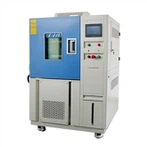
What is the temperature and humidity cycle test?
In the natural environment, temperature and humidity are inseparable two natural factors, in different regions due to different geographical locations, the temperature and humidity effects are also different. For example, the northern region of China is a low temperature and low humidity environment in winter, while the southern region is a high temperature and high humidity environment in summer. The temperature and humidity cycle test is used to confirm the adaptability of the product to storage, transportation, and use under the temperature and humidity climate conditions. The severity of the test depends on high/low temperature, humidity, and exposure duration.
Temperature and humidity cycle test according to the standard
Environmental tests-Part 2: Test methods Test Z/AD: Combined temperature/humidity cycle test IEC 60068-2-38:2009
Environmental tests-Part 2: Test methods Test Z/AD: Combined temperature/humidity cycle test GB/T 2423.34-2012
Temperature and humidity cycle test suitable products
Temperature and humidity cycle testing is mainly for instrument materials, electrical, electronic products, household appliances, auto and motorcycle parts, chemical coatings, aerospace products and other related product parts.
Purpose and conditions of temperature and humidity cycle test
The purpose of the test is to determine the adaptability of the test sample to use and storage under hot and humid conditions with temperature cycle change and condensation on the surface.
Test equipment: high and low temperature (wet and hot) test chamber (SERTEP, etc.)
Test conditions: selected temperature, humidity, number of cycles, temperature change rate, duration.
Temperature and humidity cycle test ability
1. Temperature range: -70℃ -150℃, humidity range: (20%~98%)RH, volume ≤0.08m³;
2. Temperature range: -40℃ -150℃, humidity range: (20%~98%)RH, volume ≤1m³.
Temperature and humidity cycle test conditions
high temperature, high temperature holding time, falling rate, low temperature, low temperature holding time, rising rate, cycle number. It is used to reveal defects in the sample caused by a "breathing" action other than hygroscopicity.
In the natural climate, Temperature and Humidity are inseparable environmental conditions, and the environmental conditions often appear different with the geographical location. For example, the winter in the north of our country is a low temperature and low humidity environment, while the summer in the south is a high temperature and high humidity environment. Regardless of geographical location, there are four combined states in the temperature and humidity environment: Including high temperature/humidity, high temperature/humidity, low temperature/humidity and low temperature/humidity.
Different from other wet heat cycle experiments, the accelerated 《breathing》 and the freezing effect of water adsorbed in the gap of the test sample are the basic characteristics of this experiment, and the degree of condensation depends on the thermal time constant of the sample surface. This experiment is used to confirm the adaptability of the product in the temperature and humidity climate conditions for storage, transportation and use. As a simulation of the natural environment, the temperature and humidity cycle can assess the adaptability of products under different environmental conditions, and is often used in the type test and component screening test of products in the development stage. The severity of the test depends on high/low temperature, humidity and exposure duration.