Corrosion is a major challenge for many industrial products. Metal parts used in outdoor environments are constantly exposed to salt air, humidity, and pollution. These conditions can quickly lead to rust, coating failure, and structural damage. Because corrosion often develops slowly in real environments, manufacturers need accelerated testing methods to evaluate product durability.
LIB ASTM B117 Salt Spray Corrosion Test Chamber simulates corrosive environments in a controlled laboratory setting. It generates continuous salt fog using a 5 % NaCl solution at 35 ℃, allowing laboratories and manufacturers to evaluate corrosion resistance and coating durability according to internationally recognized standards such as ASTM B117, ISO 9227, JIS Z 2371, and so on.
Customers like Anuar from Kazakhstan have praised the chamber, saying: "Cool experimental tool to assess environmental capabilities of specimens and structures. The HMI is easy to understand and the user manual is well documented. Continuous monitoring from the producer side is reliable, and customer service is very satisfactory. I recommend this equipment." This feedback highlights how the LIB S-750/25A chamber combines precise testing with excellent support.
Materials That Can Be Tested in an ASTM B117 Salt Spray Corrosion Test Chamber
1. Metal Components and Structural Parts
ASTM B117 salt spray chambers are widely used to test metal components that must resist corrosion during long-term use. Industries such as automotive, aerospace, marine engineering, and construction regularly perform these tests before products are released to the market. Typical materials include carbon steel, stainless steel, aluminum alloys, galvanized steel, and copper-based alloys.
During the test, samples are exposed to a continuous salt fog environment generated from a 5 % sodium chloride solution. The chamber temperature is maintained at 35 °C, while the pH value of the solution remains between 6.5 and 7.2. These conditions accelerate corrosion processes, helping engineers quickly evaluate material durability and identify potential failure risks.
2. Protective Coatings and Surface Treatments
Salt spray testing is also essential for evaluating protective coatings that are applied to metal surfaces. Many industries rely on coatings to prevent corrosion and extend product service life. Examples include electroplated zinc coatings, nickel plating, chrome plating, powder coatings, industrial paints, and anodized aluminum finishes.
By exposing coated samples to salt fog environments defined by ASTM B117 or ISO 9227, manufacturers can observe coating blistering, rust formation, and surface degradation. This process helps verify whether the coating system can effectively protect the base material when exposed to harsh environments such as coastal climates or salted winter roads.
3. How LIB Ensures Accurate Salt Spray Testing
Accurate corrosion testing requires precise control of environmental parameters. LIB salt spray chambers are designed to reproduce ASTM B117 conditions with high stability and repeatability. The system maintains a salt fog deposition rate of 1–2 mL per 80 cm² per hour, ensuring uniform exposure for all test samples inside the chamber.
This accuracy is achieved through several key technologies. High-quality quartz spray nozzles generate fine and evenly distributed salt mist, while corrosion-resistant spray towers guide the fog throughout the chamber. In addition, PT-100 Class A temperature sensors combined with PID control maintain chamber temperature fluctuations, ensuring consistent and reliable test results.
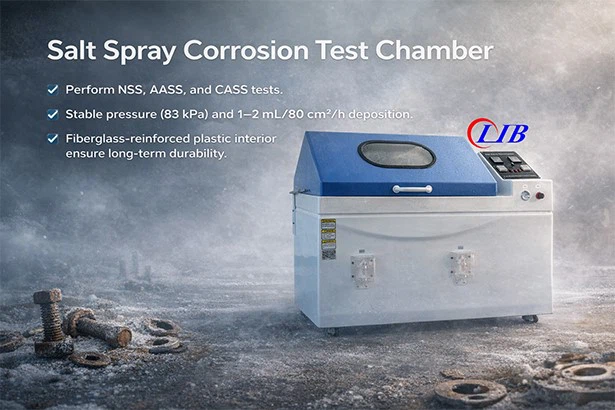
Salt Spray Corrosion Test Chamber for ASTM B117 Test
Metal Corrosion Testing Based on ASTM B117
1. Standard Requirements and Test Cycle
The ASTM B117 standard, titled Standard Practice for Operating Salt Spray (Fog) Apparatus, defines the basic operating conditions for salt spray corrosion testing. According to this standard, the chamber operates with a 5 % sodium chloride solution, a chamber temperature of 35 ± 2 °C, and a solution pH between 6.5 and 7.2. The spray pressure typically ranges from 70 kPa to 170 kPa, while the salt fog deposition rate remains between 1 and 2 mL per 80 cm² per hour.
The duration of the test depends on the product and industry requirements. Basic corrosion resistance tests may last 24 to 96 hours, while automotive components often undergo 240 to 480 hours of exposure. High-performance coatings or marine components may require 720 hours or more to verify long-term durability.
2. LIB Chamber Example for ASTM B117 Testing
A typical example is the LIB S-800 Salt Spray Corrosion Test Chamber, which is designed specifically for ASTM B117 testing. The chamber supports temperature control from ambient conditions up to 60 °C, allowing stable corrosion simulation across different testing scenarios. The internal structure ensures uniform salt fog distribution while maintaining the standard 1–2 mL/80 cm²/h deposition rate required by ASTM B117.
The chamber capacity of 800 liters allows laboratories to test multiple samples simultaneously, making it suitable for automotive components, coated metal panels, fasteners, and electronic housings. This enables efficient evaluation of corrosion performance before products enter large-scale production.
3. Advantages of LIB Salt Spray Chambers
LIB chambers are designed to provide stable corrosion testing environments with precise environmental control. Advanced PID controllers and high-accuracy sensors ensure that temperature and spray conditions remain consistent throughout long testing cycles.
|
Model |
S-150 |
|||
|
Internal dimensions (mm) |
470*590*400 |
|||
|
Overall dimensions (mm) |
620*1400*1050 |
|||
|
Temp. Range |
Ambient ~ +60 degree |
 |
||
|
Temp. Fluctuation |
± 0.5 ℃ |
|||
|
Temp. Deviation |
± 2.0℃ |
|||
|
Humidity Range |
95 % ~ 98 % RH |
|||
|
Salt Fog Deposition |
1~2ml / 80cm2 · h |
|||
|
Spray Type |
Continuous / Periodic |
|||
|
Heating Element |
Nichrome heater |
|||
|
Salt Fog Collected |
Fog collector and fog measure cylinder |
|||
|
Controller |
PID controller |
|||
|
Material |
Glass fiber reinforced plastics |
|||
|
Standard Configuration |
8 round bars and 7 V-shaped grooves |
|||
|
salt spray tower |
cylinder |
spray collector |


The equipment also features corrosion-resistant structural materials, including SUS304 stainless steel interiors and durable external coatings, allowing long-term operation even under aggressive salt environments.
In addition, the chamber includes automated spray systems and easy-to-maintain components, helping laboratories reduce maintenance time while maintaining consistent testing performance.
Maintenance Guide for LIB ASTM B117 Salt Spray Corrosion Test Chambers
1. Regular Cleaning of the Chamber
Salt residues can accumulate inside the chamber after long testing cycles. To maintain stable testing conditions, the chamber interior should be cleaned regularly using fresh water. Removing salt deposits helps prevent nozzle blockage and ensures consistent salt fog distribution during future tests.
2. Inspection of Spray Nozzles and Sensors
Spray nozzles and sensors play a critical role in maintaining accurate testing parameters. Operators should periodically inspect quartz spray nozzles for blockages and verify the performance of PT-100 temperature sensors. This ensures that chamber temperature and spray distribution remain within the tolerance limits defined by ASTM B117.
3. Monitoring the Water Supply System
The saturated barrel and water inlet system should be checked regularly to ensure sufficient water levels. Maintaining proper water supply prevents dry heating and ensures continuous salt fog generation throughout long testing cycles.
FAQs on the LIB ASTM B117 Salt Spray Corrosion Test Chamber
Q1: How long does it take to deliver a LIB ASTM B117 Salt Spray Corrosion Test Chamber?
Delivery time typically ranges from 7 to 15 days, depending on the chamber size and any customization requirements. Standard models are usually available for faster shipment. Each chamber is delivered with a detailed installation guide, operation manual, and remote technical support to help users set up the equipment quickly and start testing without delays.
Q2: What after-sales service does LIB provide for the salt spray chamber?
LIB provides a 3-year warranty and lifetime technical support for all ASTM B117 salt spray chambers. Our professional English-speaking service team is available to assist customers with troubleshooting, operation guidance, and maintenance advice. If a technical issue cannot be resolved remotely, LIB will arrange replacement solutions to minimize laboratory downtime.
Q3: Can the LIB salt spray corrosion test chamber be customized?
Yes. LIB offers flexible customization options to meet different testing requirements. Customers can request custom chamber sizes, special sample holders, and tailored testing programs based on product dimensions or testing standards. The chamber can be configured to meet international standards such as ASTM B117, ISO 9227, JIS Z 2371, and GB/T 10125.
Q4: What industries commonly use ASTM B117 salt spray testing?
ASTM B117 salt spray testing is widely used in industries where corrosion resistance is critical. Typical applications include automotive components, electronic enclosures, metal fasteners, marine equipment, industrial coatings, and aerospace parts. The test helps manufacturers evaluate coating durability and material corrosion resistance under accelerated salt fog conditions.
Contact LIB Industry to learn more and request your customized equipment today.