Engineers in modern labs test products under extreme temperatures and humidity to uncover hidden weaknesses before real-world use.
LIB Benchtop Climate Test Chambers provide a compact yet powerful solution for laboratories requiring precise temperature and humidity control. Igor, a customer from Israel who purchased four units, shared his experience: "Everything is working fine with the climate test chambers. Your support and guidance have been very helpful. If there are any updates or issues, I will let you know. Thanks again for your assistance." This feedback highlights how LIB chambers deliver reliability, precision, and customer confidence in a bench-sized footprint.
Original feedback email:

This article highlights how LIB Benchtop Climate Test Chambers, with temperature ranges from –86 °C to +150 °C and humidity control from 20 % to 98 % RH, provide precise, repeatable environmental simulation for electronics, pharmaceuticals, and aerospace testing in a compact laboratory footprint.
Temperature and Humidity Ranges of the Benchtop Climate Test Chambers
1. Ultra-Low Temperature Simulation (–86 °C to 0 °C)
Benchtop chambers simulate freezing storage, polar, and high-altitude conditions for electronics, batteries, and aerospace components. Controlled cooling at 1 °C/min with compressor-based cascade refrigeration and PT100 Class A sensors (0.001 °C resolution) keeps temperature stable within ±0.5 °C, preventing brittleness, solder cracking, and reduced battery performance.
2. High-Temperature Environmental Testing (+25 °C to +150 °C)
High-temperature tests evaluate thermal resistance, component aging, and heat tolerance, simulating conditions up to 120 °C for vehicles, industrial equipment, and outdoor electronics. Electric heaters with PID control raise temperatures up to 3 °C/min, maintaining precise, repeatable conditions in line with IEC 60068-2-2 (Dry Heat) and MIL-STD-810 Method 501.
3. Wide-Range Humidity Control (20 %–98 % RH)
Humidity testing prevents corrosion, insulation failure, and condensation damage. Chambers control 20–98 % RH using steam humidification and refrigeration-based dehumidification, with closed-loop water recycling reducing consumption by 50 % and maintaining ±2.5 % RH stability. Supports IEC 60068-2-78, IEC 60068-2-30, and ASTM D2247 standards.
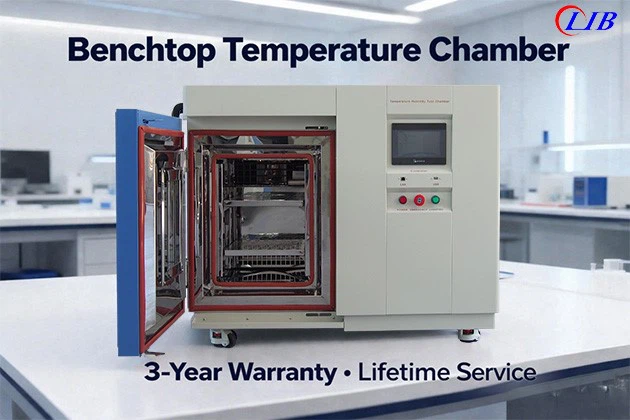
Climate Test Chambers for Thermal Cycling Test
Applications and Testing Methods of Benchtop Climate Test Chambers
1. Electronics Reliability Testing
Electronic components must maintain performance under changing environmental conditions. Temperature and humidity chambers are widely used to conduct tests according to standards such as:
a. IEC 60068-2-1 – Cold Test
b. IEC 60068-2-2 – Dry Heat Test
c. IEC 60068-2-78 – Damp Heat Steady State
Typical testing procedures include temperature cycling, high-humidity soak tests, and condensation exposure. Engineers often run 72-hour humidity exposure at 40 °C and 93 % RH to verify PCB insulation resistance and connector reliability.
2. Automotive and Aerospace Environmental Qualification
Automotive electronic control units (ECUs), sensors, and wiring systems must survive extreme climates. Climate chambers help simulate these environments using standardized methods such as:
ISO 16750-4 – Environmental Conditions for Electrical Equipment
MIL-STD-810 Method 507 – Humidity Testing
IEC 60068-2-14 – Temperature Cycling
Typical procedures involve rapid heating and cooling cycles between –40 °C and +85 °C, repeated dozens of times to detect material fatigue or electronic drift.
3. Pharmaceutical and Biotechnology Stability Testing
Temperature and humidity chambers are also used in pharmaceutical laboratories to verify drug stability and packaging reliability.
Relevant standards include:
ICH Q1A(R2) – Stability Testing of New Drug Substances
ASTM F1980 – Accelerated Aging of Medical Devices
Typical testing conditions include:
25 °C / 60 % RH (long-term storage)
40 °C / 75 % RH (accelerated aging)
These tests ensure medicines remain chemically stable and packaging materials maintain their protective properties.
Real Case: Electronic Product Testing Based on IEC 60068-2-78
One of the most widely used environmental testing standards for temperature and humidity is IEC 60068-2-78. This standard evaluates how electronic components perform when exposed to high humidity and elevated temperatures for extended periods.
Manufacturers commonly apply this test to evaluate PCB insulation reliability, connector corrosion resistance, and electronic component stability under humid climates.
1. Typical IEC 60068-2-78 Test Cycle
A standard damp-heat test cycle usually includes the following steps:
a. Pre-conditioning stage
Samples are stabilized at 23 °C ±2 °C and 50 % RH ±5 % for 2 hours to ensure consistent starting conditions.
b. Temperature and humidity ramp
The chamber temperature gradually increases to 40 °C ±2 °C, while humidity rises to 93 % RH ±3 %.
c. Humidity exposure stage
Test samples remain under 40 °C / 93 % RH conditions for 48–96 hours, depending on product requirements.
d. Recovery stage
After exposure, samples are returned to standard laboratory conditions (23 °C / 50 % RH) before functional inspection and electrical testing. This process helps engineers detect potential issues such as: Moisture-induced corrosion, Insulation degradation, Electrical leakage, Material swelling or deformation.
2. Testing Workflow Using LIB Benchtop Climate Chambers
In many electronics laboratories, engineers perform this procedure using LIB Benchtop Climate Test Chambers (TH-50 or TH-80) to precisely control temperature and humidity conditions.
The chamber maintains:
a. Temperature stability: ±0.5 °C
b. Humidity accuracy: ±2.5 % RH
c. Uniform airflow distribution for consistent exposure
After the humidity test cycle is completed, products may undergo additional environmental verification such as dust protection tests in an IP6X dust resistant sand and dust test chamber to confirm enclosure sealing performance. Combining humidity stress testing and dust ingress testing allows engineers to evaluate both internal component reliability and external enclosure protection, ensuring the product can withstand harsh real-world environments.
3. Why LIB Benchtop Climate Test Chambers Are Popular
|
|
|
|||||
| Model | TH-50 | TH-80 | ||||
| Internal dimension (mm) |
320x350x450 |
400x400x500 | ||||
| Overall dimension (mm) | 800x1050x950 | 900×1100×1000 | ||||
| Temperature range | -86 ℃ ~+150 ℃ | |||||
| Temperature fluctuations | ± 0.5 ℃ | |||||
| Humidity Range | 10%/20%~95 % | |||||
| Temperature deviation | ± 2.0 ℃ | |||||
| Temperature Sensor | PTR Platinum Resistance PT100Ω/MV A-class | |||||
| Temperature Resolution | ± 0.001 ℃ | |||||
| Exterior Material | Steel Plate with A protective coating | |||||
| Interior Material | SUS 304 stainless steel | |||||


a. Compact Laboratory Design with Ultra-Quiet Operation
50 L and 80 L chamber models fit easily on laboratory benches, saving valuable floor space while maintaining full environmental testing capability.
b. High-Precision Environmental Control
Temperature stability of ±0.5 °C and humidity deviation within ±2.5 % RH ensure highly repeatable and accurate test results.
c. 7-15 Days Fast Delivery and Global Support
LIB provides three-year warranty coverage and lifetime technical support, helping laboratories maintain stable long-term testing operations.
FAQs on the Benchtop Climate Test Chambers
Q1: What temperature range do benchtop climate chambers typically support?
Most models cover –40 °C to +150 °C, while advanced versions extend down to –86 °C for ultra-low-temperature testing.
Q2: What humidity range can be controlled?
Standard chambers maintain humidity between 20 % and 98 % RH, supporting most environmental simulation standards.
Q3: Which industries commonly use benchtop climate chambers?
Electronics manufacturing, automotive engineering, aerospace research, pharmaceuticals, and material science laboratories frequently rely on these chambers.
Q4: How accurate are benchtop climate chambers?
High-quality chambers maintain ±0.5 °C temperature stability and ±2.5 % RH humidity accuracy, ensuring repeatable test conditions.
Any customization can be made. LIB offers a 3-year warranty and lifetime service. Any issues that cannot be resolved during the warranty period will be replaced free of charge. 24/7 English-speaking after-sales team. Fast shipping within 7-15 days.
Contact LIB Industry today to discover how Benchtop Climate Test Chambers can improve your product reliability testing and accelerate your R&D process.