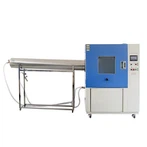
Choosing the wrong weathering chamber can cost a lab months of retesting, a failed audit, or a product recall traced back to UV degradation nobody caught in time. Engineers who buy on price alone often discover, six months in, that their "equivalent" chamber cannot hold the ±2°C black-panel tolerance or the 0.51 W/(m²·nm) irradiance band that ISO 4892-2 actually demands.
This article walks through what separates a genuinely reliable ISO 4892-2 xenon test chamber manufacturer from a chamber that merely looks compliant on a spec sheet, using LIB Industry as the working example, then compares the ISO 4892-2 xenon-arc method against the ASTM G154 UV fluorescent method so you can decide which one - or both - belongs in your lab.
LIB Industry as a Reliable ISO 4892-2 Xenon Test Chamber Manufacturer
Manufacturing Strength
LIB Industry builds its xenon-arc chambers around a water-cooled 4500 W lamp system, plug-and-play daylight and window-glass filter sets, and a color touchscreen controller that supports up to 120 programs with 100 steps each. Every unit is calibrated on the production line before shipment, and each chamber carries a 3-year warranty backed by lifetime technical support, with an English-speaking support team and spare-parts warehouses that target 7–15 day delivery worldwide. That combination of in-house lamp production, calibration, and after-sales infrastructure is what lets a manufacturer promise repeatable results years after installation, not just on day one.
Standards Met and Working Principle
ISO 4892-2 asks for a xenon arc, filtered to reproduce daylight, that exposes specimens to controlled irradiance, temperature, humidity, and wetting. LIB Industry's chambers are built to hold broadband irradiance at 60 ± 2 W/m² (300–400 nm) or 0.51 ± 0.02 W/(m²·nm) at 340 nm for daylight-filter (Method A) testing, and 50 ± 2 W/m² or 1.10 ± 0.02 W/(m²·nm) at 420 nm for window-glass-filter (Method B) testing - matching Cycle 1 and Cycle 5 of the standard's default tables. Black-

panel or black-standard temperature is held within ±3°C, chamber air within ±3°C, and relative humidity within ±10%, using a PID controller reading PT100 and black-panel sensors in real time. The working principle is straightforward: the xenon arc simulates the ultraviolet and visible spectrum of sunlight, the filters shape that spectrum to match daylight or daylight-through-glass, and the control loop keeps light, heat, and moisture locked to the target cycle for the full test duration.
Test Methods Supported
LIB Industry's chambers run the standard's default Cycle 1 pattern out of the box - 102 minutes of dry exposure followed by 18 minutes of water spray, repeated continuously - and can be reprogrammed for any of the eight temperature-and-humidity combinations described across the standard's Method A and Method B tables, including elevated 100°C black-standard cycles for accelerated thermal-stress testing. Spray water is filtered to the conductivity and dissolved-solids limits the standard requires, and a rotating specimen rack keeps irradiance uniform across every position in the chamber, so results from one run can be compared fairly with the next.
| Parameter | Method A (daylight filter, Cycle 1) | Method B (window-glass filter, Cycle 5) |
|---|---|---|
| Broadband irradiance (300–400 nm) | 60 ± 2 W/m² | 50 ± 2 W/m² |
| Narrowband irradiance | 0.51 ± 0.02 W/(m²·nm) at 340 nm | 1.10 ± 0.02 W/(m²·nm) at 420 nm |
| Black-panel / black-standard temperature | ±3°C tolerance | ±3°C tolerance |
| Chamber air temperature | ±3°C tolerance | ±3°C tolerance |
| Relative humidity | ±10% tolerance | ±10% tolerance |
Électricité de France Trusts LIB Industry for Cable Climatic Ageing Testing
Électricité de France (EDF), one of the world's largest electric utility companies, operates extensive power transmission and distribution networks and needed a testing partner who could meet a demanding combination of irradiation and low-temperature requirements. The case shows how far a xenon chamber's engineering has to stretch beyond the standard's default cycles.
Requirement. In April 2023, EDF's engineers contacted LIB Industry regarding a cable testing project. The project called for cable environmental testing in accordance with EN 50483-6, with the chamber required to meet the standard's irradiation specification while also reaching a minimum temperature of -40°C, so that the equipment could simulate real-world outdoor climatic ageing on power cables rather than just laboratory-warm exposure.
LIB Industry's Solution. Based on EDF's requirements and the EN 50483-6 specifications, LIB Industry recommended the XL-S-750C low-temperature xenon test chamber. The unit was configured to deliver the irradiation levels the standard requires across the 300–400 nm wavelength range while still reaching temperatures as low as -40°C, pairing full-spectrum xenon exposure with a cooling system built for genuine sub-zero cable ageing rather than standard room-temperature cycling.
|
|
Model |
XL-S-750 ISO 4892-2 xenon test chamber |
|
Internal Dimension (mm) |
950*950*850 mm |
|
|
Overall Dimension (mm) |
1300*1420*1800 mm |
|
|
Sample holder |
Adjustable speed, 1r /min |
|
|
Chamber Type |
Rotating Holder |
|
|
Irradiation Source |
1 piece of 4500w water-cooled xenon arc lamp with inner quartz and outer borosilicate filter |
|
|
Irradiance Range |
150 W/㎡ |
|
|
Bandwidth Measurement |
300~400 nm |
|
|
Chamber Temperature Range |
-40~ 100 ℃ ±2 ℃ |
|
|
Black Panel Temperature |
BPT 35 ~ 85 ℃ ±2 ℃ |
|
|
Humidity Range |
30 % ~ 98 % RH |
|
|
Water Spray Cycle |
1~9999 H 59 M (Adjustable) |
|
|
Controller |
Programmable color LCD touch screen controller |
|
|
Radiometer |
UV Radiometer, Tolerance: ±5 % |


Project Result. After technical discussions confirmed the solution, EDF placed an order for the XL-S-750C. The chamber was delivered and put into operation in November 2023, giving EDF's team stable, repeatable environmental simulation conditions to support its cable testing and long-term reliability validation program.
This project shows the same pattern seen across LIB Industry's customer base. Engineers bring a demanding, standard-specific requirement, here EN 50483-6 irradiation combined with -40°C low-temperature capability, and LIB Industry configures the chamber to meet it rather than asking the customer to compromise on the test method.
ISO 4892-2 Xenon Test Chamber vs. ASTM G154 UV Test Chamber: How to Choose
Both standards accelerate weathering, but they simulate different parts of sunlight and suit different failure modes.
| Feature |
|
ASTM G154 UV Chamber |
|---|---|---|
| Light source | Xenon arc (full daylight spectrum, 290–800 nm) | Fluorescent UV lamps (UVA-340, UVB-313, UVB-351, typically 40 W each, up to 8 lamps) |
| Spectrum match | Simulates full daylight or daylight-through-glass | Simulates only the UV portion of sunlight |
| Best suited for | Materials where visible-light fading, color change, and full-spectrum degradation matter (coatings, automotive plastics, textiles) | Materials where UV-driven degradation dominates (roofing, geotextiles, some polymers) |
| Irradiance control | 60 ± 2 W/m² (300–400 nm) or narrowband at 340/420 nm | Set per lamp type and program, typically measured at 340 or 313 nm |
| Temperature control | Black-panel/black-standard, ±3°C | Black-panel, similar tolerance bands |
| Sample capacity | Rotating rack, up to 42 samples | Flat aluminum holders, up to 52 standard specimens (75 mm × 150 mm) |
| Lamp lifespan | Xenon lamp life extended to roughly 5,000+ hours with water cooling | UV lamps rated for approximately 5,000 hours |
| Relative cost | Higher upfront cost, closer daylight correlation | Lower upfront cost, simpler maintenance |


If your product's failure mode is primarily color fade, gloss loss, or chalking under real sunlight - automotive trim, outdoor furniture, printed graphics - an ISO 4892-2 xenon chamber gives the closest correlation to field results. If the concern is purely UV-driven chain scission in polymers, such as roofing membranes or agricultural film, an ASTM G154 UV chamber can deliver faster, lower-cost screening. Many labs run both: UV chambers for early-stage material screening, xenon chambers for final validation before certification.
Popular Aging Test Chambers

Accurate Sunlight Simulation, Reliable Weathering Results, ASTM G155 Compliant Testing

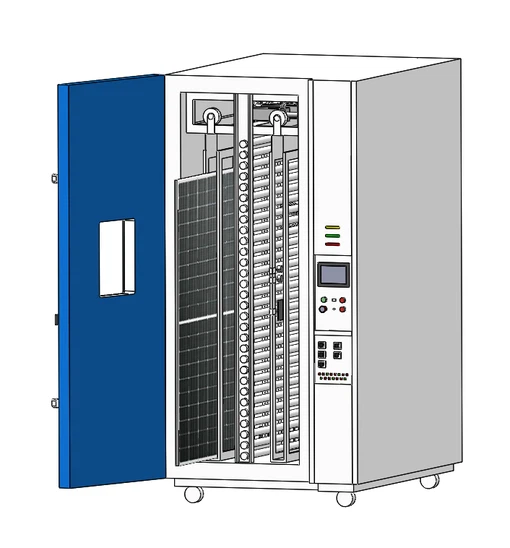
Designed for Solar Module Durability Testing, Stable UV Irradiance Control

Reproduce Real Climate Conditions, Enhance Product Reliability

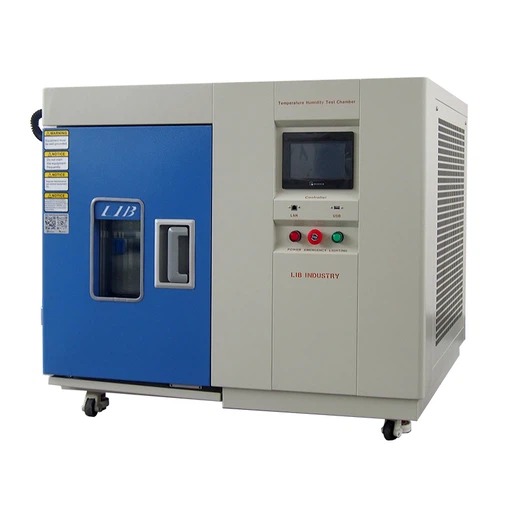
FAQs on the ISO 4892-2 Xenon Test Chamber
Q1: Does LIB Industry offer installation support and training?
Yes. Every chamber ships with installation guidance, and on-site or remote operator training is available so new staff can run their first program correctly.
Q2: What is the standard shipping and delivery timeline?
Chambers are built to order and typically ship within a few weeks of confirmation; spare parts are stocked in global warehouses and generally arrive within 7–15 days after a warranty or service request.
Q3: Can the chamber be customized for oversized or irregular samples?
Yes, bespoke sample holders and programmable cycles can be configured at no extra charge to match unusual shapes, large panels, or non-standard test sequences.
Q4: What happens if the chamber develops a fault after installation?
LIB Industry provides a 3-year warranty and lifetime technical support; if an issue cannot be resolved remotely, the chamber is replaced free of charge.
Q5: Do the chambers meet international safety and environmental standards?
Yes, units are built to CE, IEC, and CSA safety requirements and follow ISO 14001 environmental management practices, alongside full compliance with ISO 4892-2 test parameters.
Contact Us for Your Test Chamber Needs
If you're in the market for a weathering test chamber, whether it's an ISO 4892-2 Xenon Test Chamber, anASTM G155 UV Test Chamber, a UV Exposure Chamber for PV Modules, or a Temperature and Humidity Aging Chamber for Composites, don't hesitate to reach out. We're ready to discuss your sample size, testing standards, irradiance requirements, and space constraints, and help you find the right weathering test solution for your laboratory.
References
LIB Industry Technical Team, Technical information, testing methods, product specifications, and application guidance for weathering and xenon-arc test equipment.