Outdoor environments can destroy materials much faster than many manufacturers expect. Continuous exposure to strong sunlight, humidity, rain, and heat can cause coatings to fade, plastics to crack, rubber to lose elasticity, and structural materials to weaken. Without proper durability testing, products that perform well in the laboratory may fail quickly in real-world conditions.
Many manufacturers are already verifying product durability using accelerated weathering equipment such as the LIB QUV accelerated weathering tester. One of our customers shared: "So far, we didn't have any problem with the UV chamber and we tested without any problems… I know that support from your side is excellent and I am grateful." - Vladimir Todorović. This feedback highlights how reliable LIB UV chambers help quality teams confidently evaluate material performance before products reach the market.

This is why accelerated weathering testing has become essential for industries such as automotive, coatings, electronics, and building materials. With advanced systems like the LIB QUV accelerated weathering tester, laboratories can reproduce years of outdoor exposure in only a few weeks, allowing manufacturers to evaluate durability and improve product reliability before market release.
Working Principle of the LIB QUV Accelerated Weathering Tester
The LIB QUV accelerated weathering tester works by reproducing the most destructive components of sunlight and moisture to accelerate material degradation in a controlled environment.
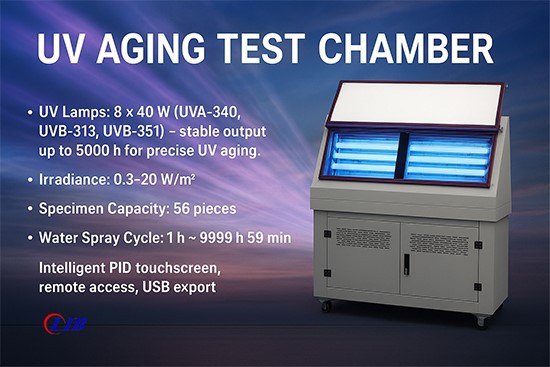
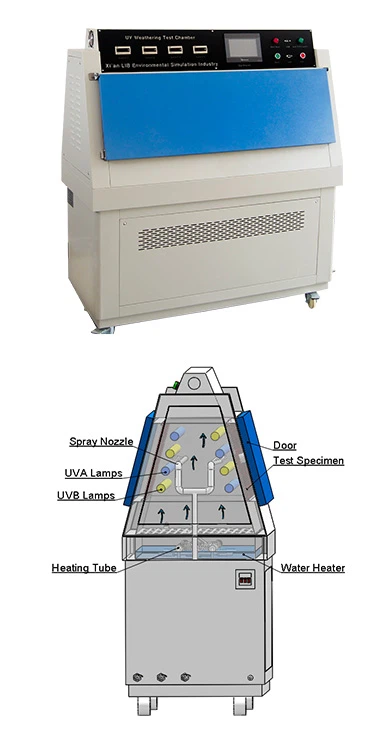
The system uses QUV fluorescent UV lamps that emit precise wavelengths commonly found in natural sunlight. Users can choose between UVA-340, UVB-313, and UVB-351 lamps, which simulate different portions of the solar spectrum. These lamps operate with stable spectral distribution and a service life of up to 5000 hours, ensuring consistent irradiance during long-term testing.
During operation, the tester alternates between UV exposure and moisture cycles. UV light initiates photochemical degradation, while condensation and water spray simulate dew and rain. The chamber can reach temperatures up to 90 °C with humidity levels of ≥95 % RH, allowing realistic environmental simulation.
The system continuously monitors key parameters such as UV irradiance and Black Panel Temperature (BPT). BPT sensors measure the combined heating effect of UV radiation and chamber temperature, providing more realistic thermal conditions similar to outdoor exposure.
In addition, the LIB QUV accelerated weathering tester is equipped with an intelligent PID control system that precisely regulates temperature, humidity, and UV irradiance throughout the testing cycle. The programmable touchscreen controller supports up to 120 testing programs with 100 steps each, allowing users to easily create customized weathering cycles that comply with international standards such as ASTM G154, ISO 4892-3, and SAE J2020.
Testing Methods, Cycles, and Time in the LIB QUV Accelerated Weathering Tester
The LIB QUV tester supports multiple international weathering standards used across industries. Common standards include:
1. ASTM G154 – Standard Practice for Operating Fluorescent UV Weathering Test Apparatus
2. ISO 4892-3 – Plastics - Methods of Exposure to Laboratory Light Sources
3. ASTM D4587 – UV Exposure of Coatings
4. SAE J2020 – Accelerated Exposure of Automotive Exterior Materials
These standards define different test cycles to simulate sunlight and moisture exposure.
|
Model |
UV-SI-260 |
|
|
Internal Dimension (mm) |
450*1170*500 |
|
|
Overall Dimension (mm) |
680*1300*1500 |
|
|
Irradiation Source |
Fluorescent UV lamps (8) - 40 W |
|
|
Temperature Range |
Ambient ~ 90 ℃ ±2℃ |
|
|
Black Panel Temperature (BPT) |
35 ~ 80 ℃ |
|
|
Humidity Range |
≥95% RH |
|
|
Bandwidth |
290 ~ 400 nm |
|
|
Irradiance Control |
0.3~20 W/㎡ |
|
|
Distance of Specimen and lamp |
50 mm |
|
|
Heating Element |
Nichrome heater |
|
|
Controller |
Programmable color LCD touch screen controller |
|
|
Ethernet connection, PC Link,USB |
||
|
Water Supply System |
Automatic water supply, Water purification system |
|
|
Interior Material |
SUS304 stainless steel |
Method 1: ASTM G154 Cycle (Most Common for Coatings and Plastics)
ASTM G154 is one of the most widely used methods for accelerated UV weathering.
Typical cycle example:
Step 1 – UV Exposure
Temperature: 60 °C
Duration: 8 hours
UV source: UVA-340 lamp
LIB Advantage:
The chamber's UV irradiance radiometer continuously monitors lamp output and automatically adjusts intensity through the PID control system to maintain stable radiation levels.
Step 2 – Condensation Cycle
Temperature: 50 °C
Duration: 4 hours
LIB Advantage:
The high-precision humidity system creates 100 % condensation conditions, accurately reproducing overnight dew formation on materials.
This 12-hour cycle repeats automatically, allowing laboratories to simulate months or years of outdoor exposure in only 1–4 weeks.

Method 2: UV + Water Spray Weathering Cycle
Some materials require additional rain simulation.
Typical conditions:
UV exposure temperature: 70 °C
Water spray rate: ≈0.3 L/min
Spray system: 10 nozzles
LIB Advantage:
The automated spray system simulates rain under UV exposure, making test environments closer to real outdoor conditions while improving testing efficiency.
How to Choose Between a QUV Accelerated Weathering Tester and a Xenon Test Chamber?
Both QUV testers and xenon chambers are widely used for weathering resistance testing. However, they simulate sunlight differently and are suited for different applications.
The QUV tester focuses on ultraviolet radiation and moisture cycles, while the xenon chamber reproduces the full solar spectrum including UV, visible, and infrared light according to standards such as ASTM G155 and ISO 4892-2.
| Feature |
QUV Accelerated Weathering Tester |
|
|---|---|---|
| Light Source | Fluorescent UV lamps | Xenon arc lamp |
| Spectral Range | Mainly UV (280–400 nm) | Full sunlight spectrum (280–800 nm) |
| Typical Standard | ASTM G154, ISO 4892-3 | ASTM G155, ISO 4892-2 |
| Testing Speed | Very fast accelerated aging | More realistic sunlight simulation |
| Typical Applications | Coatings, plastics, rubber | Automotive parts, textiles, paints |
| Equipment Cost | Lower investment | Higher investment |


In general:
Choose QUV testing when focusing on UV degradation and fast screening.
Choose xenon testing when full-spectrum sunlight simulation is required.
FAQs on the QUV Accelerated Weathering Tester
Q1: How long does a QUV accelerated weathering test take?
Most accelerated tests run between 500 and 2000 hours, depending on the required durability level and testing standard.
Q2: What materials can be tested in a QUV tester?
Common materials include coatings, plastics, rubber, automotive components, textiles, and construction materials.
Q3: How many samples can the LIB QUV tester hold?
The chamber supports up to 52 adjustable sample holders, ensuring uniform UV exposure for multiple specimens.
Q4: Why is Black Panel Temperature important?
BPT reflects the combined heating effect of sunlight and air temperature, providing more realistic outdoor simulation.
Q5: How stable is the UV irradiance during testing?
LIB chambers use real-time irradiance monitoring and PID feedback control, ensuring stable UV intensity throughout long tests.
Accelerated weathering testing is essential for verifying product durability before market release. With precise UV simulation, intelligent control systems, and compliance with international standards such as ASTM G154, ISO 4892-3, and SAE J2020, the LIB QUV accelerated weathering tester provides reliable and repeatable aging data for modern materials testing.
Contact LIB Industrytoday to discover how our advanced QUV and xenon weathering chambers can improve your product reliability and testing efficiency.