
The four-gas (NO2, Cl2, H2S, SO2) Mixed Flowing Gas Corrosion Test Chamber simulates harsh air environments to test how well electronic products resist corrosion. This kind of test has strict requirements for gas concentration, temperature and humidity. If the gas is not clean, or the equipment is not properly maintained, the test results become inaccurate and the equipment itself is more likely to develop problems.
A customer of LIB Industry reported that the inside of its test chamber was corroded and asked for repair. When our technicians inspected the chamber on site, they found that this was not corrosion. The gas used by the customer contained too many impurities. These impurities formed small particles that gradually stuck to the inner walls of the chamber's workroom.

Following the standard IEC 60068-2-60, we solved the problem in three steps.
Step 1: Distinguish Corrosion from Surface Deposits and Clean the Test Chamber
The two cases can look alike, but they need completely different treatment, so the first job is to tell them apart.
True corrosion: The material itself has been damaged. The surface shows small pits, becomes rough or changes color, and the damage remains even after wiping clean.
Impurity deposits: Dirt is simply stuck to the surface. Once it is removed, the material underneath is still intact.
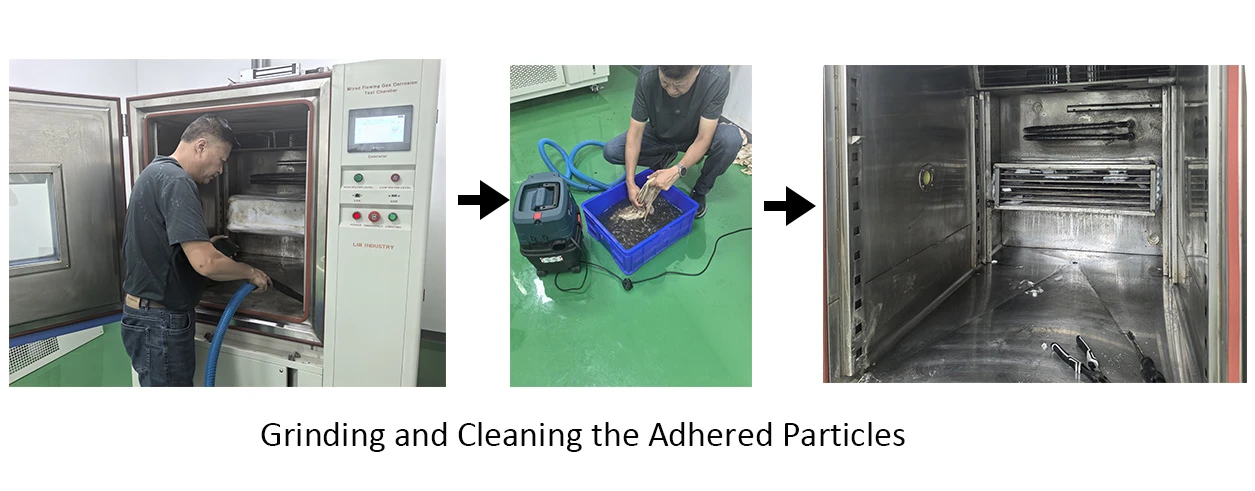
This case was the second type. The wall was covered with a layer of hard small particles, and after they were removed the inner wall was undamaged, which showed that the chamber had not been corroded.
The standard also states that the chamber should be easy to clean thoroughly on the inside. Our cleaning steps were:
Stop the machine, shut off the gas and ventilate the chamber fully. The gases inside are toxic, so the door is opened only after confirming it is safe.
Take out the samples, the sample racks and any removable parts.
Gently grind the particles off the wall. Use the specified tools and a light touch, so that the wall is not scratched. Scratches make the wall more likely to adsorb gas in the future.
Wipe off the residue, rinse with water, then let it dry.
While you are there, check the gas inlet, the gas outlet and other areas, and clear any particles found.
 Step 2: Use Clean Gas with Filters at the Gas Source
The root cause was an unclean gas source. Impurities entered the chamber along with the gas and slowly settled on the inner walls and in the piping.
The standard has requirements for how clean the gas and air must be: the air and water used in the test must be clean enough not to affect the test.
We therefore recommended that the customer use NO2, Cl2, H2S and SO2 gas cylinders supplied by LIB Industry. With clean gas and accurate mixing ratios, there is less particle contamination and the concentrations are more stable, which also protects the chamber, piping, valves and gas sensors.
We also installed a filter on the gas source side, so that the gas passes through it and leftover particles are held back before the gas enters the test chamber. The filter should be checked, cleaned or replaced regularly, since a blocked filter will also affect the gas flow.

Step 3: Precautions for using toxic gases and daily maintenance
After the repair, we explained to the customer how to operate and maintain the test chamber. The key points are as follows.
Safety first. All four gases are toxic. The room must be ventilated, gas leak alarms must be in place, and exhaust gas must be treated according to local regulations.
Operate according to the standard test method. Stabilize the temperature and humidity first, then introduce the gases, and do not let the gas concentration overshoot. The adjustment and stabilization period must not exceed 24 hours.
Keep the noxious gas supply clean. The noxious gas source must be free of impurities and particles, as contaminants can accumulate inside the test chamber, block gas lines, and damage internal components. Use a suitable gas filter and regularly inspect the gas supply system to keep the equipment clean and operating properly.
A dirty test chamber is not necessarily a corroded one. LIB Industry first determined whether the issue was corrosion or impurity deposits, avoiding unnecessary part replacement and identifying the real cause: unclean gas. With clean gas, a filter at the gas source, correct operating procedures and regular maintenance, the test chamber can stay stable over the long term, with fewer unexpected shutdowns.


