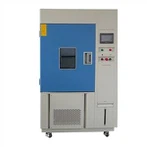
When products are exposed to extreme outdoor or industrial conditions, dust, water, and high-pressure cleaning can cause critical failures. Electronics may short-circuit, seals may fail, and components may degrade if not properly protected. Ensuring reliable ingress protection is essential for automotive, electronics, defense, and industrial products.
LIB's IP69K Test Chamber offers a complete solution for validating both dust-tightness and waterproofing, providing repeatable results while complying with global standards. The system integrates advanced PID control, uniform airflow, closed-loop water circulation, and flexible specimen mounting to simulate the harshest real-world conditions efficiently.
1. Understanding IP69K Testing
IP69K testing evaluates products against the highest levels of environmental protection. The first digit in the IP code, IP6X, indicates complete dust-tightness: no particles can enter the enclosure, even under vacuum conditions. The second digit, X9K, signifies resistance to high-pressure, high-temperature water jets.
For water testing, IPX9K simulates industrial wash-downs or extreme rainfall, delivering water at pressures of 8,000–10,000 kPa and temperatures up to +88 °C from four nozzles at angles of 0°, 30°, 60°, and 90°, each spraying for 30 seconds per position. For dust testing, the chamber uses 50 µm nominal-diameter dust with a vertical airflow system, maintaining concentrations of 2–4 kg/m³ at ambient to +50 °C.
This combination ensures that products remain operational under conditions that replicate real-world challenges, from road dust infiltration to high-pressure cleaning in automotive or industrial applications.
2. International Standards for IP69K Test Chambers
IP69K testing must comply with recognized international standards to ensure results are accurate and certifiable. Common standards include:
IEC 60529: Defines the IP rating system for solid and liquid ingress.
ISO 20653: Specifies road vehicle electrical equipment testing against dust and water.
IEC 60068-2-68: Environmental testing of components under dust and sand exposure.
DIN 40050-9: Automotive ingress protection standards.
ASTM & MIL Standards: Industrial and defense-specific durability requirements.
Among these, IEC 60529 is the most frequently referenced standard for IP69K. It details exact water flow, pressure, temperature, duration, and nozzle positions to ensure repeatable results.
How is IP69K testing performed according to IEC 60529?
Water Spray Setup: Four stainless-steel nozzles deliver water at +88 °C under 8,000–10,000 kPa pressure. The spray covers angles of 0°, 30°, 60°, and 90°, exposing all surfaces evenly. Each nozzle sprays for 30 seconds while the specimen rotates on a turntable at 5 ± 1 r/min.
Specimen Mounting: Items up to 50 kg can be placed on an adjustable turntable (height 200–400 mm, tilt up to 15°). Smaller components can be suspended for uniform exposure. Custom fixtures prevent movement during high-pressure spray.
Water Flow Control: PID-controlled electromagnetic flow meters maintain flow rates of 14–16 L/min with ±0.01 kPa pressure deviation. A closed-loop water circulation system ensures stable temperature and pressure, reduces water consumption by up to 80%, and prevents nozzle blockage.
Dust Testing: The chamber circulates 50 µm dust at 2–4 kg/m³ through vertical airflow, while a heating tube prevents caking. Vacuum pressure and airflow are continuously monitored for compliance with IP6X standards. Specimens may be placed on the floor or suspended to simulate real-world dust exposure.
By following IEC 60529, LIB ensures each test produces reliable, repeatable, and certification-ready results for both dust and water ingress.

IP Test Chamber For Dustproof and Waterproof test
3. Advantages of LIB IP6X and IPX9K Chambers
IP6X Dust Ingress Test Chamber
LIB's IP6X dust chamber guarantees complete dust-tightness. Its vertical airflow circulation ensures even dust distribution, while heating tubes prevent clumping. Standard specimen holders support up to 50 kg, and vacuum pressure monitoring provides precise control over testing conditions. Built-in wipers and lighting allow continuous observation without interrupting the cycle.
|
|
|
| Name | IPX6 Dust Test Chamber |
|
Workroom dimension (mm) |
800*800*800 D*W*H |
|
External dimension (mm) |
950*3150*1800 D*W*H |
|
Interior Volume (L) |
510 |
|
Diameter of Turntable (mm) |
600 |
|
Turntable loads |
20kgs Max |
|
Turntable Rotation Speed |
0~7r/min (Adjustable) |
|
Internal Diameter of IPX5 Nozzle |
6.3 mm |
|
Internal Diameter of IPX6 Nozzle |
12.5 mm |
|
Water Flow Rate IPX5/ IPX6 |
12.5L/min ±5% / 100L/min ±5% |
|
Controller |
Programmable color LCD touch screen controller |
|
Ethernet connection, PC Link, USB |
|
|
Build-in Water Tank(mm) |
370*375*950 |
|
View Window Size(mm) |
475*475 |


 |
 |
|
| Test Area | LAN and USB | Controller |

IPX9K High-Pressure Water Jet Test Chamber
The IPX9K section simulates extreme water exposure with four high-temperature, high-pressure nozzles and an automated turntable. PID-controlled electromagnetic flow ensures precise pressure and flow stability. The waterproof power supply allows live-function testing, verifying operational integrity of electronics or lighting fixtures during the spray. Closed-loop water circulation maintains consistent test conditions, reduces water usage, and prevents nozzle blockages.
|
|
Model |
R9K-1200 |
|
Internal Dimensions (mm) |
1000*1000*1000 |
|
|
Overall Dimensions (mm) |
1300*1500*2030 |
|
|
Interior Volume (L) |
1000 |
|
|
Water Spray Angle |
0°, 30°, 60°, 90° |
|
|
Water Spray Temperature |
Ambient ~ +88℃ (Adjustable) |
|
|
Spray Nozzle |
Four, 30 Seconds each position |
|
|
Distance from Water Spraying to Specimens |
10~15 cm |
|
|
Water Pressure |
8000-10000 Kpa (Adjustable) |
|
|
Water Flow Rate |
14L-16L/min |
|
|
Testing Platform Speed |
5±1 r.p.m |
|
|
Testing Platform Height |
200-400 nm (Adjustable) |
|
|
Testing Platform Diameters |
600 mm |


Together, the dual-function IP69K chamber combines dust and water testing, saving space, reducing equipment cost, and enabling comprehensive, simultaneous ingress testing.
4. FAQs on the IP69K Test Chamber
Q1: Can small specimens move during rotation or water exposure?
No. Custom fixtures hold all items in place, even under high-pressure spray and platform rotation, maintaining test accuracy.
Q2: How is water flow regulated?
Electromagnetic flowmeters with PID control maintain water flow between 14–16 L/min and pressure at 8,000–10,000 kPa ±0.01 kPa.
Q3: Can the chamber maintain temperature without continuous heating?
The PID-controlled heating tube ensures stable ambient to +50 °C for dust tests and +88 °C for water tests, automatically adjusting to maintain set temperatures.
Q4: Can devices remain powered during testing?
Yes. The waterproof power supply enables live-function testing, critical for electronics, lighting systems, and sensors.
Q5: What safety features are included?
Over-current, earth leakage, over-temperature, and phase sequence protection safeguard both equipment and operators.
Q6: Which standards does the chamber comply with?
IEC 60529 (IP6X/IPX9K), ISO 20653, IEC 60068-2-68, DIN 40050-9, ASTM, and MIL standards for dust and waterproof testing.
LIB's IP69K Test Chamber provides an industry-leading solution for dust and water ingress testing. With precise pressure, temperature, and flow control, it delivers repeatable, standards-compliant results for automotive, industrial, and defense applications. The dual-function chamber saves space, reduces water consumption, and allows full live-function testing, giving manufacturers confidence that their products can withstand the harshest real-world conditions.
Contact LIB Industry today to customize your IP69K Test Chamber, schedule a live demo, or receive technical support-elevate your dust and waterproof testing capabilities with confidence.