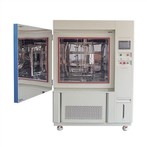
Outdoor products are exposed to ultraviolet radiation, heat, rain, humidity, and condensation every day. Over time, these environmental factors can cause coating fading, cracking, chalking, yellowing, gloss loss, and material degradation. A UV Weathering Resistance Test Chamber helps manufacturers reproduce years of outdoor aging within weeks or months inside the laboratory.
An Australian customer using the LIB UV Weathering Resistance Test Chamber recently shared positive feedback after receiving maintenance support from LIB's after-sales team. After sensor adjustment and troubleshooting guidance, the customer confirmed: "Works perfectly fine now." LIB also provided a complete UV Test Chamber Maintenance Processing List to help the customer perform regular maintenance and ensure stable long-term chamber operation. This practical support helps customers reduce downtime and maintain accurate testing performance throughout the equipment lifecycle.
This article explains how to properly maintain a UV Weathering Resistance Test Chamber for long-term stable operation, compares UV and xenon weathering technologies, and shows how LIB UV chambers support coating aging tests according to international standards such as ASTM G154, ISO 4892-3, SAE J2020, and other standards.
UV Weathering Resistance Test Chamber Maintenance Methods
1. Heating and Humidity System Maintenance
The heating and humidification systems directly affect temperature stability and condensation accuracy. Regular maintenance helps the chamber maintain stable environmental conditions during long-term accelerated aging tests.
Operators should inspect the heating tubes every 6 months and measure heater resistance. A normal resistance value is approximately 8 Ω. If the temperature controller displays abnormal symbols such as "- -", the temperature sensor connection or sensor itself should be checked immediately. The humidifier heater, wet wick, and float ball should also be cleaned regularly to prevent scale buildup and inaccurate humidity readings. LIB recommends replacing yellow or moldy wet wicks immediately to maintain humidity accuracy above 95% RH.
Compared with natural outdoor exposure testing, a UV Weathering Resistance Test Chamber can maintain precise temperature control up to 90°C and continuous humidity cycling regardless of seasonal climate changes. Natural testing may take 1–3 years, while accelerated UV testing can reproduce similar degradation within hundreds or thousands of hours.
This maintenance process supports compliance with: ASTM G154, ISO 4892-3, SAE J2020 and other standard
Typical industries include: Automotive coatings, powder coatings, plastics, rubber products, outdoor construction materials.
2. Exposure and UV Irradiance System Maintenance
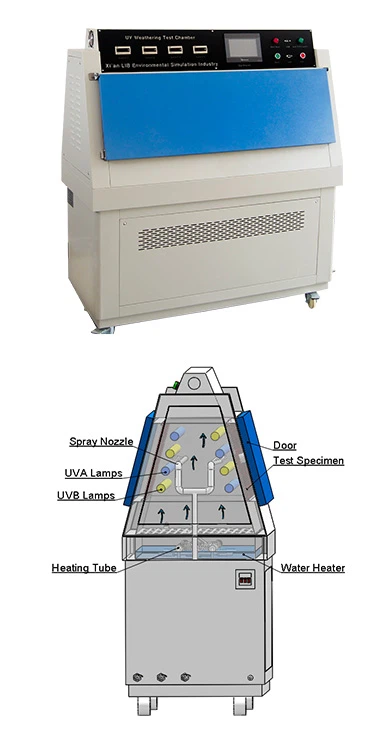
The UV lamp system is the core component of the UV Weathering Resistance Test Chamber. LIB UV chambers use imported QUV lamps including UVA-340, UVB-313, and UVB-351. Regular inspection ensures accurate ultraviolet wavelength simulation throughout the test cycle.
Operators should check whether the lamp tubes illuminate normally and inspect ballast resistors and wire connections. The radiometer surface should be cleaned using alcohol to remove dust and limescale. UV lamps typically provide stable spectral power distribution for up to 5000 hours. Maintaining stable irradiance is critical because international standards require accurate UV intensity control.
Unlike natural sunlight testing, UV chambers can maintain consistent UV irradiance 24 hours a day without weather interruptions. Outdoor sunlight intensity changes continuously due to seasons, clouds, and geographical location, while laboratory UV testing ensures repeatable and standardized results.
3. Spray and Electrical System Maintenance
The spray system simulates rain and moisture exposure during UV aging tests. LIB UV chambers use 10 spray nozzles with an automatic water supply system and a flow rate of approximately 0.3 L/min.
Operators should clean spray nozzles regularly to prevent clogging and inspect water pipes to ensure there are no cross-knotted sections that restrict water flow. The water tank float ball and filter element should also be cleaned monthly, while the filter cartridge should be replaced once per year.
For the electrical system, maintenance personnel should inspect relays, contactors, circuit boards, and PID controllers. Dust removal using compressed air helps prevent overheating and electrical instability. The input voltage should remain at 220V, while output voltage ranges from 0–400V during operation.
Compared with outdoor exposure testing, laboratory spray systems create repeatable rain simulation cycles that are impossible to control naturally. This improves testing consistency and shortens product development time.
LIB UV Weathering Resistance Test Chamber vs Xenon Weathering Resistance Test Chamber
Both UV and xenon chambers are widely used for accelerated weathering testing, but their testing principles and applications are different.
1. UV Weathering Resistance Test Chamber① Uses fluorescent UV lamps such as UVA-340 and UVB-313 ② Primarily simulates ultraviolet degradation ③ Faster accelerated aging speed ④ Lower operating and maintenance cost ⑤ Suitable for coatings, plastics, rubber, and industrial materials ⑥Meets ASTM G154 and ISO 4892-3 |
2. Xenon Weathering Resistance Test Chamber① Uses xenon arc lamps to simulate full-spectrum sunlight ② Simulates UV, visible light, infrared radiation, rain, and humidity ③ Better for color appearance and full-spectrum aging evaluation ④ Higher purchase and maintenance costs ⑤ Suitable for automotive interiors, textiles, and color-sensitive materials ⑥ Meets ASTM G155 and ISO 4892-2 |
3. How to Choose?
① Choose a LIB UV Weathering Resistance Test Chamber if your product mainly faces ultraviolet aging problems such as cracking, chalking, yellowing, or gloss loss. UV chambers focus directly on UV degradation and provide faster accelerated aging results.
② Choose a xenon weathering chamber when full-spectrum sunlight simulation is necessary. Xenon lamps reproduce UV, visible light, and infrared radiation together, making the test environment closer to natural outdoor sunlight.
③ If you need lower operating costs and easier maintenance, a LIB UV Weathering Resistance Test Chamber is usually the better choice. UV lamps consume less energy and have lower replacement costs compared with xenon arc lamps.
④ For products where color fading and appearance changes are critical, such as automotive interiors, textiles, leather, and decorative materials, xenon testing provides more realistic color stability evaluation.
⑤ If your laboratory mainly performs routine quality control testing according to ASTM G154 or ISO 4892-3 standards, a LIB UV Weathering Resistance Test Chamber offers higher testing efficiency, stable repeatability, and faster turnaround time for industrial material durability evaluation.


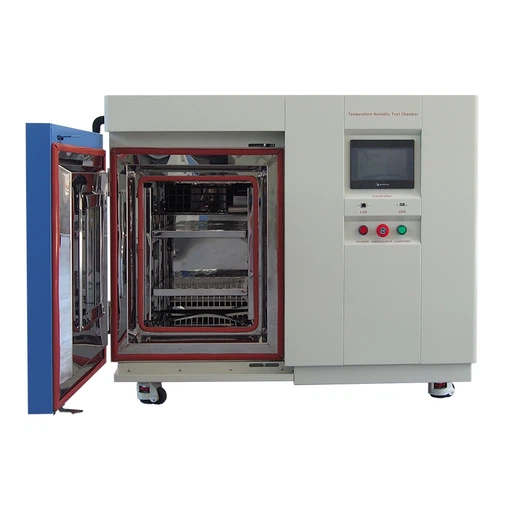
LIB UV Weathering Resistance Test Chamber for Coating Aging Testing
One of the most commonly used coating aging standards is ASTM G154.
1. ASTM G154 Cycle 1 Requirements
Cycle:
① 8 hours UV exposure at 60°C using UVA-340 lamps
② 4 hours condensation at 50°C
This cycle continuously repeats to simulate long-term outdoor moisture and ultraviolet exposure.
2. Recommended LIB Model
LIB UV-SI-260 UV Weathering Resistance Test Chamber
|
Model |
UV-SI-260 |
|
|
Internal Dimension (mm) |
450*1170*500 |
|
|
Overall Dimension (mm) |
680*1300*1500 |
|
|
Irradiation Source |
Fluorescent UV lamps (8) - 40 W |
|
|
Temperature Range |
Ambient ~ 90 ℃ ±2℃ |
|
|
Black Panel Temperature (BPT) |
35 ~ 80 ℃ |
|
|
Humidity Range |
≥95% RH |
|
|
Bandwidth |
290 ~ 400 nm |
|
|
Irradiance Control |
0.3~20 W/㎡ |
|
|
Distance of Specimen and lamp |
50 mm |
|
|
Heating Element |
Nichrome heater |
|
|
Controller |
Programmable color LCD touch screen controller |
|
|
Ethernet connection, PC Link,USB |
||
|
Water Supply System |
Automatic water supply, Water purification system |
|
|
Interior Material |
SUS304 stainless steel |
|
| Standards | ASTM G154, ASTM G15, ISO 4892, ASTM D4329, ISO 16474-3, IEC 61215, IEC 61730 | |
3. Advantages of LIB UV Weathering Resistance Test Chamber
① Accurate UV Simulation
Imported QUV lamps provide stable spectral output and meet ASTM and ISO testing standards with high repeatability.
② Intelligent PID Control
The programmable touchscreen controller precisely controls UV irradiance, temperature, spray, and humidity cycles automatically.
③ Realistic Environmental Simulation
The chamber combines UV, heat, condensation, and rain simulation in one integrated testing system.
④ Easy Maintenance Design
Modular lamp installation, accessible spray systems, and convenient electrical layouts reduce maintenance time significantly.
⑤ Reliable Long-Term Operation
SUS304 stainless steel interior, stable radiometer monitoring, and automatic alarms improve equipment durability and testing reliability.
A coating manufacturer used the LIB UV-SI-260 to evaluate outdoor architectural coatings according to ASTM G154. After 1000 hours of accelerated aging, the laboratory successfully identified gloss reduction and micro-cracking issues before product release, reducing field failure risk and improving coating durability performance.
FAQs on the UV Weathering Resistance Test Chamber
Q1: How often should UV lamps be replaced?
Normally after approximately 5000 working hours to maintain stable UV irradiance output.
How often should maintenance be performed?
Basic inspections should be conducted monthly, while complete electrical and heating system inspections are recommended every 6 months.
q2: Can LIB chambers meet international standards?
Yes. LIB UV chambers support ASTM G154, ISO 4892-3, SAE J2020, GB/T 14522, and other international weathering standards.
q3: Does LIB provide overseas installation and training?
Yes. LIB provides remote technical support, video guidance, operation training, and overseas installation services.
q4: How is the chamber transported internationally?
LIB chambers are packed in strong export plywood cases with anti-vibration protection and moisture-proof packaging for safe international transportation.
q5: What is the typical delivery time?
Standard models usually require 20–30 working days depending on configuration requirements.
q6: Does LIB provide after-sales support?
Yes. LIB offers technical support, spare parts supply, maintenance guidance, and 3 years after-sales service for global customers.
Contact LIB Industry to obtain a professional UV weathering testing solution tailored to your product and industry requirements.