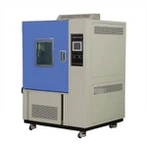
When you're testing automotive materials, electronic components, pharmaceutical products, or industrial coatings, unstable temperature or humidity can completely change the final result. Even a ±2 °C fluctuation may lead to failed validation, repeated testing, delayed product launches, or inconsistent data between laboratories. That is why environmental simulation accuracy has become one of the most important requirements in modern reliability testing.
Recently, a customer from Romania shared positive feedback after installing a LIB Constant Condition Climate Chamber: "The chamber has been successfully installed, and to the best of my knowledge, everything is working well. I haven't received any complaints from my colleagues. If any issues come up in the future, we will contact you. Thank you." The chamber is now being used for continuous environmental simulation and product reliability validation in laboratory applications, helping the customer perform stable and efficient aging tests under controlled temperature and humidity conditions.
This article explains how a Constant Condition Climate Chambercontrols temperature and humidity with high precision, how it differs from natural environment testing, what international standards it satisfies, and how LIB chambers help laboratories complete automotive aging tests faster and more reliably.
How Does a Constant Condition Climate Chamber Control Temperature and Humidity Accurately?
1. Precise Temperature and Humidity Control Technology
A Constant Condition Climate Chamber uses a closed-loop PID control system to continuously monitor and adjust internal conditions. LIB chambers use PT100 Class A platinum resistance sensors with ±0.001 °C resolution to detect even the smallest temperature change in real time.
For humidity control, the chamber combines steam humidification, refrigeration dehumidification, and wet-bulb sensing technology to maintain stable moisture levels within ±2.5 % RH. Temperature stability can remain within ±0.5 °C during long-duration tests.
To eliminate hot or cold areas, LIB uses dual centrifugal airflow fans and precision air ducts. This creates uniform air circulation throughout the workspace, keeping chamber uniformity within ±1.5 °C. Whether testing a small PCB sensor or a large automotive assembly, every sample experiences the same conditions.
2. Difference Between Chamber Testing and Natural Environment Testing
Natural outdoor testing depends on weather, seasons, sunlight intensity, rainfall, and geographical location. A material exposed outdoors in Arizona will age differently than the same material tested in Germany or Southeast Asia. Natural testing also requires months or years to generate usable data.
A Constant Condition Climate Chamber creates repeatable environmental conditions independent of external climate. Engineers can precisely set temperature ranges from –70 °C to +180 °C and humidity from 10 % to 98 % RH. Typical applications include 85 °C/85 % RH damp heat testing for electronic reliability evaluation, –40 °C low-temperature storage testing, thermal cycling between –40 °C and +85 °C for automotive components, and high-temperature aging tests at 150 °C for material durability verification.
Because conditions remain stable 24 hours a day, the chamber can accelerate aging significantly faster than natural exposure while maintaining repeatability between laboratories worldwide.
3. Standards Supported and Industry Applications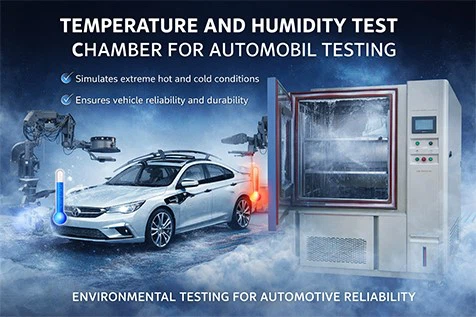
Constant condition climate chambers are widely used in automotive, electronics, aerospace, battery, pharmaceutical, textile, and military industries. Many reliability certifications require strict compliance with international environmental standards, including:
① IEC 60068-2-1 Low Temperature Test
② IEC 60068-2-2 Dry Heat Test
③ IEC 60068-2-30 Damp Heat Cyclic Test
④ IEC 60068-2-78 Constant Damp Heat Test
⑤ ISO 16750 Environmental Conditions for Automotive Electronics
⑥ ASTM D4332 Conditioning for Packaging Testing
⑦ JESD22-A101 Steady-State Temperature Humidity Bias Testing
⑧ ISO 4892 Artificial Weathering for Plastics
For automotive suppliers, chambers are commonly used to validate dashboards, interior plastics, wire harnesses, ECU modules, connectors, sensors, and battery components before OEM approval.
Working Principle of the LIB Constant Condition Climate Chamber
The LIB Constant Condition Climate Chamber combines refrigeration, heating, humidification, dehumidification, and airflow systems into one integrated environmental simulation platform.
The refrigeration system uses imported compressors and environmentally friendly refrigerants to achieve stable low-temperature control. Stainless steel electric heaters quickly increase chamber temperature, while PID algorithms continuously balance heating and cooling output to prevent overshoot.
Humidity is generated through a steam humidification system and controlled by automatic water supply and recirculation technology. Excess moisture is removed through the refrigeration evaporator, allowing precise humidity reduction during cyclic testing.
During operation, sensors continuously send temperature and humidity data to the programmable controller every second. The touchscreen controller automatically adjusts compressor load, heating power, fan speed, and humidification output to maintain target conditions.
LIB chambers support up to 120 programmable test profiles with 100 programmable steps per profile, as well as Ethernet and USB data export, real-time graph monitoring, and a multi-language operation interface. The equipment structure uses SUS304 stainless steel interiors for corrosion resistance and easy cleaning, while 100 mm polyurethane insulation improves energy efficiency and temperature stability.
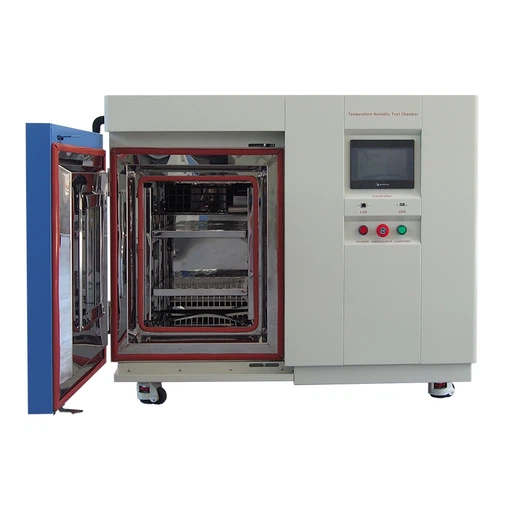
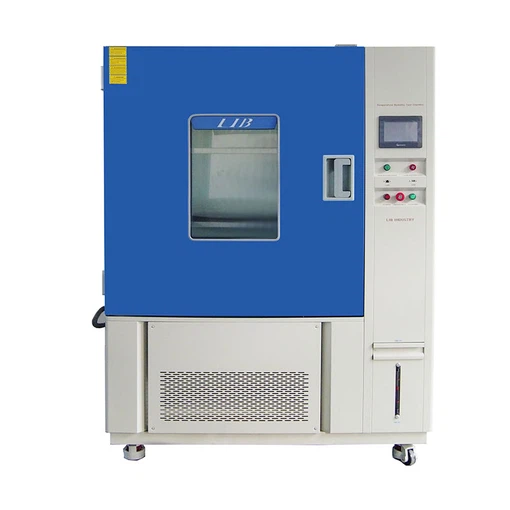
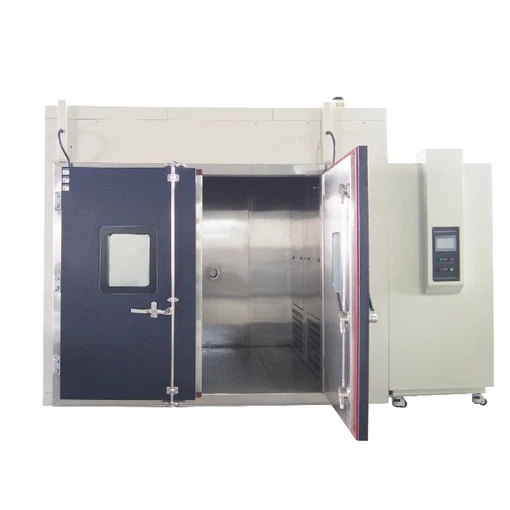


LIB Constant Condition Climate Chamber for Automotive Material Aging Testing
1. Common Automotive Standard: PV1200 Damp Heat Aging Test
One of the most commonly used automotive environmental standards is PV1200, widely applied for validating automotive interior and exterior materials under temperature and humidity stress conditions.
Typical PV1200 damp heat aging requirements include:
|
Temperature: 80 °C Relative Humidity: 95 % RH Test Duration: 240 h to 1000 h depending on material type Evaluation Items: Surface cracking Gloss change Adhesion failure |
Color fading Dimensional deformation For cyclic testing, the chamber may also perform: Heating from ambient to 80 °C Humidity stabilization at 95 % RH Long-duration holding periods Cooling back to ambient conditions |
2. Recommended LIB Chamber Model
For this application, the LIB TH-225 Constant Condition Climate Chamber is widely used.
Typical specifications:
|
|
Name | Temperature Humidity Climatic Chamber for Composites | ||||
|
Model |
TH-100 |
|||||
|
Internal dimension (mm) |
400*500*500 |
|||||
|
Overall dimension (mm) |
860*1050*1620 |
|||||
|
Capacity |
100L |
|||||
|
Temperature range |
-20℃ ~+150 ℃ |
|||||
|
Low type |
A: -40℃ B:-70℃ C -86℃ |
|||||
|
Humidity Range |
20%-98%RH |
|||||
|
Temperature deviation |
± 2.0 ℃ |
|||||
|
Heating rate |
3 ℃ / min |
|||||
|
Cooling rate |
1 ℃ / min |
|||||
|
Controller |
Programmable color LCD touch screen controller, Multi-language interface, Ethernet , USB |
|||||
|
Refrigerant |
R404A, R23 |
|||||
|
Exterior material |
Steel Plate with protective coating |
|||||
|
Interior material |
SUS304 stainless steel |
|||||
|
Standard configuration |
1 Cable hole (Φ 50) with plug; 2 shelves |
|||||
|
Timing Function |
0.1~999.9 (S,M,H) settable |
|||||

|
|
|
|
|
|
| Robust Workroom | Cable Hole | Temperature and Humidity Sensor | PID controller |


The euipment can complete automotive damp heat aging, electronic reliability validation, and accelerated durability testing within one integrated system.
3. Advantages of LIB Constant Condition Climate Chambers
① Fast Thermal Response
Heating and cooling transitions reduce total testing time and improve laboratory throughput for OEM qualification programs.
② Excellent Uniformity
Optimized airflow design ensures consistent exposure across all test samples, reducing repeat tests caused by uneven conditions.
③ Energy-Saving Operation
Water recirculation and high-efficiency insulation reduce both water and electricity consumption by 20–30 %.
④ Easy Maintenance
Modular refrigeration systems, accessible filters, and automatic alarms simplify routine servicing and minimize downtime.
⑤ Flexible Customization
LIB supports customized cable holes, reinforced shelves, sliding racks, and special fixture designs for different automotive components.
FAQs on the Constant Condition Climate Chamber
Q1: How accurate is the chamber during long-term testing?
LIB chambers maintain ±0.5 °C temperature stability and ±2.5 % RH humidity stability even during continuous 1000-hour aging tests.
q2: Can the chamber comply with automotive OEM standards?
Yes. LIB chambers support testing according to IEC 60068, ISO 16750, PV1200, SAE standards, and many customized OEM validation procedures.
q3: How long does installation take?
Most standard models arrive fully assembled. Installation and startup can normally be completed within 2 hours using standard power and water connections.
q4: Can LIB customize the chamber?
Yes. LIB provides customized chamber sizes, shelving systems, cable ports, viewing windows, humidity systems, and controller functions according to customer applications.
q5: What after-sales support does LIB provide?
LIB provides: 24/7 English technical support, Video troubleshooting assistance, Remote software support, Spare parts supply, On-site training and commissioning services.
Q6: How are Equipment transported internationally?
Chambers are packed in reinforced export wooden crates with anti-vibration protection and moisture-proof wrapping. LIB supports sea freight, air freight, and door-to-door logistics services worldwide.
LIB's Constant Condition Climate Chamber combines precision control, rapid cycling, stable long-term operation, and international-standard compliance in one integrated solution. From automotive material aging to electronic reliability validation, LIB helps laboratories generate repeatable and trusted environmental test data efficiently.
ContactLIB Industry today for chamber specifications, application consultation, customization solutions, or a live demonstration.