Corrosion is one of the biggest reasons metal products fail in real environments. Automotive parts rust after winter road salt exposure, marine hardware corrodes in coastal humidity, and electronic connectors lose conductivity because of salt contamination. Waiting for natural outdoor exposure can take months or even years, which slows product development and increases failure risk.
A customer from Kazakhstan using the LIB S-750 Salt Spray Chamber ASTM B117 shared positive feedback after long-term operation. According to Anuar and his team, the chamber has operated smoothly without difficulties. He described the equipment as a "cool experimental tool to assess environmental capabilities of specimen and structures," and especially appreciated the easy-to-understand HMI interface, detailed user manual, and reliable customer support. He also highlighted LIB's continuous monitoring assistance and responsive after-sales service, recommending the equipment for corrosion and environmental testing applications.
This article explains what a Salt Spray Chamber ASTM B117 is used for, which industries rely on it most, what standards are commonly required, and how LIB's Salt Spray Chamber ASTM B117 delivers stable, repeatable, and standards-compliant corrosion testing for modern laboratories and manufacturers.
Salt Spray Chamber ASTM B117 Used For
1. Automotive Industry Corrosion Testing
The automotive industry is one of the most common users of ASTM B117 salt spray chambers. Vehicle components such as bolts, brake systems, wheel hubs, radiators, zinc-coated steel parts, and aluminum alloys are constantly exposed to road salt, rainwater, humidity, and temperature changes. These harsh environments can rapidly damage coatings and reduce vehicle durability.
To verify corrosion resistance, manufacturers commonly perform testing according to ASTM B117, ISO 9227 NSS, SAE J2334, and OEM internal standards. ASTM B117 uses a continuous 5% NaCl salt fog environment at 35 °C, while ISO 9227 Neutral Salt Spray (NSS) requires a pH range of 6.5–7.2 and a salt deposition rate of 1–2 mL/80 cm²/h.
Compared with outdoor exposure testing, which may require 1–3 years, salt spray testing can simulate long-term corrosion effects within 24 hours to several weeks. This allows automotive manufacturers to evaluate electroplating, powder coatings, e-coatings, and galvanized layers much faster while maintaining realistic and repeatable results.
2. Marine and Offshore Equipment Testing
Marine environments contain high humidity, salt air, and chloride contamination that continuously attack metal surfaces. Salt Spray Chamber ASTM B117 systems are widely used for marine hardware, offshore equipment, fasteners, ship coatings, stainless steel parts, and aluminum structures.
Testing in this field commonly follows ASTM B117, ISO 9227 AASS, and ISO 9227 CASS standards. AASS (Acetic Acid Salt Spray) lowers the pH to 3.1–3.3 using acetic acid to create a more aggressive corrosion environment for decorative coatings and plated components. CASS testing adds 0.26 g/L CuCl₂ to further accelerate corrosion for high-performance finishes.
These tests simulate years of coastal exposure within a controlled laboratory environment. Manufacturers use them to compare coating quality, improve anti-corrosion systems, and verify long-term reliability before products enter marine service.
3. Electronics and Electrical Component Testing
Electronics manufacturers use ASTM B117 salt spray chambers to evaluate corrosion resistance of connectors, terminals, circuit housings, communication equipment, sensors, and electrical enclosures. In humid coastal regions or industrial environments, salt contamination can cause oxidation, poor conductivity, and short circuits.
Common standards include ASTM B117, IEC 60068-2-11, ISO 9227 NSS, and MIL-STD corrosion testing procedures. The chamber reproduces highly corrosive salt fog environments using controlled temperature, spray pressure, and salt concentration.
Compared with natural environmental exposure, accelerated salt spray testing greatly shortens product qualification cycles while maintaining realistic corrosion mechanisms. This helps electronics manufacturers improve sealing performance, coating durability, and long-term operational stability.
Popular salt and Climatic chambers for Salt Fog and Marine Exposure Tests


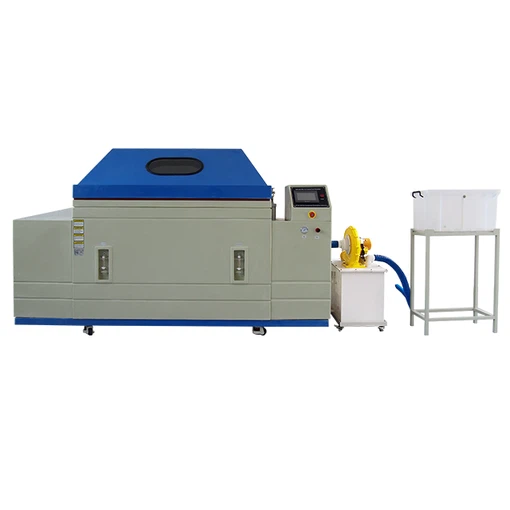


LIB Salt Spray Chamber ASTM B117 Standard Requirements
LIB's Salt Spray Chamber ASTM B117 is designed to fully comply with ASTM B117 and ISO 9227 corrosion testing standards. The system maintains stable and repeatable environmental conditions required for neutral salt spray testing and accelerated corrosion evaluation.

| Parameter | ASTM B117 / ISO 9227 NSS Requirement |
|---|---|
| Salt Solution | 5% NaCl |
| Chamber Temperature | 35 ± 2 °C |
| Saturated Air Barrel Temperature | 47 °C |
| pH Range | 6.5–7.2 |
| Spray Pressure | 83 kPa |
| Deposition Rate | 1–2 mL/80 cm²/h |
| Temperature Fluctuation | ±0.5 °C |
| Temperature Deviation | ±2 °C |
|
salt spray tower |
cylinder |
spray collector |


The chamber uses precision quartz spray nozzles and a corrosion-resistant spray tower to generate uniform salt fog distribution. A saturated air barrel preheats and humidifies compressed air before atomization, stabilizing salt concentration and reducing testing variability.
PID intelligent control combined with PT-100 Class A sensors ensures precise temperature monitoring throughout long-duration testing. Real-time monitoring of spray pressure, chamber temperature, humidity, and testing duration guarantees compliance with ASTM B117 operational requirements.
LIB Salt Spray Chamber ASTM B117 for Coating Testing
One of the most common coating standards used with salt spray chambers is ISO 9227 Neutral Salt Spray (NSS) testing for zinc plating, electroplated coatings, powder coatings, and painted metal surfaces.
A. Typical ASTM B117 Salt Spray Test Cycle
① Prepare a 5% sodium chloride (NaCl) solution.
② Maintain chamber temperature at 35 ± 2 °C.
③ Maintain spray pressure at approximately 83 kPa.
④ Keep salt fog collection rate at 1–2 mL/80 cm²/h.
⑤ Continuously atomize salt solution to create a uniform corrosive fog environment.
⑥ Expose coated specimens for 24, 48, 96, 240, 480, 720, or 1000+ hours depending on coating specifications.
⑦ Inspect samples for blistering, rust formation, coating delamination, oxidation, and corrosion spread after testing.
B. Recommended LIB Model: Salt Spray Chamber ASTM B117
The LIB Salt Spray Chamber ASTM B117 is designed specifically for continuous corrosion testing of coatings and plated materials. The chamber supports NSS, AASS, and CASS testing in one system and allows programmable multi-stage corrosion cycles.
C. Advantages of LIB Salt Spray Chamber ASTM B117
1. Stable Salt Fog Generation
Quartz spray nozzles maintain uniform atomization at 83 kPa, ensuring consistent salt deposition throughout long testing cycles.
2. Intelligent PID Environmental Control
PT-100 sensors and PID control maintain chamber stability within ±0.5 °C, reducing test deviations and improving repeatability.
3. Smart Program Management
The touchscreen controller stores up to 120 programs with 100 steps each, allowing automated NSS, AASS, and CASS cycle switching.
4. Real-Time Monitoring and Reporting
Temperature, spray duration, humidity, and pH values are continuously logged and exported through USB or Ethernet for audit-ready reports.
5. Durable Corrosion-Resistant Structure
The A3 steel exterior and corrosion-resistant internal components are designed for long-term laboratory operation with minimal maintenance requirements.
FAQs on the LIB Salt Spray Chamber ASTM B117
Q1: Can the chamber perform both ASTM B117 and ISO 9227 testing?
Yes. LIB chambers support ASTM B117, ISO 9227 NSS, AASS, and CASS corrosion testing standards in one integrated system.
Q2: How long does a typical salt spray test take?
Testing duration depends on the coating and standard requirements. Common exposure times range from 24 hours to 1000+ hours.
Q3: Does LIB provide installation and technical support overseas?
Yes. LIB provides global installation guidance, remote troubleshooting, and lifetime technical support with English-speaking engineers available 24/7.
Q4: How are chambers shipped internationally?
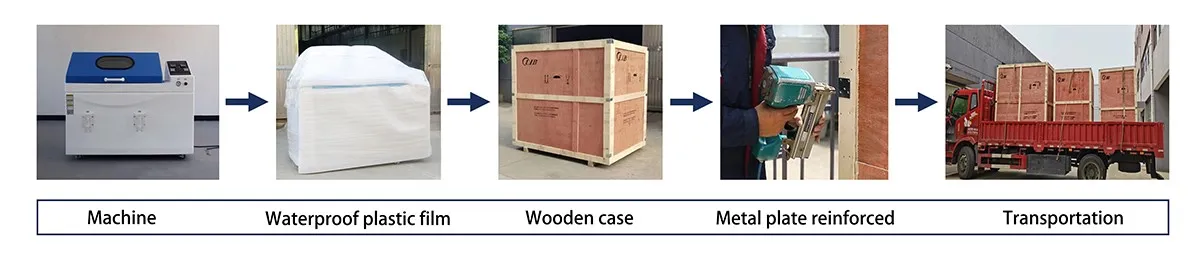
LIB chambers are packaged with reinforced export wooden cases and shock-protection materials to ensure safe international transportation by sea, air, or rail freight.
Q5: What happens if replacement parts are needed?
LIB guarantees spare-part delivery within 7–15 days for most international regions. Critical components are designed for easy maintenance and replacement.
Contact LIB Industry today to learn how our Salt Spray Chamber ASTM B117 can help your laboratory achieve faster corrosion validation, more reliable coating evaluation, and full compliance with ASTM B117 and ISO 9227 standards.