When products are used near coastlines, offshore platforms, or marine transportation systems, they are constantly exposed to salt-laden air and moisture. These environments accelerate corrosion far faster than normal atmospheric conditions, often causing early failure of metals, coatings, and electronic housings. This is why engineers rely on controlled laboratory simulation instead of waiting for years of natural exposure.
A recent customer feedback from Pakistan also reflects this reliability in real applications: "We have been using the LIB instruments with complete satisfaction. The automotive sector in Pakistan is still in hot water and investment needs special consideration, but we will check this again and inform you accordingly." This confirms the practical value and trust in LIB salt chamber under real industrial conditions.
In this article, we explore how testing for exposure to marine and salt fog in a salt chamber works, where it is used, and how LIB's advanced salt fog corrosion test chamber ensures reliable and standards-compliant results.
Application Fields of Marine and Salt Fog Exposure Testing
1. Automotive Industry Corrosion Validation
In the automotive sector, salt fog testing is widely used to evaluate corrosion resistance of body panels, fasteners, electrical connectors, brake systems, and underbody coatings. Vehicles operating in coastal regions or winter-road environments face continuous exposure to chloride salts, moisture, and temperature cycling.
To ensure durability, testing commonly follows multiple international standards, including ISO 9227 NSS (Neutral Salt Spray, 5% NaCl, 35 ± 2 °C), ASTM B117, and SAE J2334 cyclic corrosion test, which better simulates real-world road salt, wet/dry cycles, and temperature variation. In OEM validation processes, additional requirements are also widely applied. These accelerated tests compress natural corrosion exposure from several years into 24–1000+ hours, significantly improving validation speed for automotive design, coating development, and supplier qualification.
2. Marine and Offshore Equipment Testing
Marine and offshore systems, including ship structures, offshore wind turbines, drilling platforms, and port infrastructure, require extreme resistance to continuous salt spray, high humidity, and cyclic wetting.
Testing is typically conducted under severe corrosion standards such as ISO 9227 AASS (Acetic Acid Salt Spray, pH 3.1–3.3), ISO 9227 CASS (Copper-Accelerated Salt Spray, 0.26 g/L CuCl₂), and ASTM G85 (Prohesion cyclic corrosion test), which simulate alternating dry and wet marine conditions. For offshore engineering validation, additional real-environment simulation standards such as ISO 20340 (coating protection for offshore structures) are often required. These methods reproduce wave splash, salt-laden wind, condensation, and long-term marine atmospheric corrosion in a highly accelerated laboratory environment.
3. Electronics and Protective Coating Evaluation
Electronic devices, control cabinets, PCB assemblies, and protective coatings are highly sensitive to chloride penetration, moisture ingress, and electrochemical corrosion, which can lead to short circuits or insulation failure.
Salt fog testing in this field typically follows IEC 60068-2-11 (basic salt mist test), IEC 60068-2-52 (cyclic salt mist exposure), and other standrads, which are widely used for defense, aerospace, and outdoor electronic systems. Additional coating and material evaluation standards such as ASTM B117 and ISO 9227 NSS are also applied to assess corrosion resistance under controlled deposition rates of 1–2 mL/80 cm²/h. These tests simulate coastal humidity, airborne salt particles, and condensation cycles, ensuring long-term reliability of sensitive electronic systems in marine or outdoor environments.
Popular salt and Climatic chambers for Salt Fog and Marine Exposure Tests


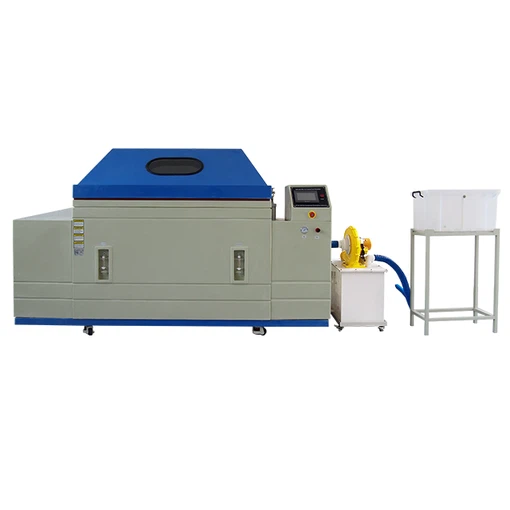


Working Principle of LIB Salt Chamber for Stable Salt Fog Control
LIB salt fog corrosion test chambers are designed to ensure uniform, repeatable, and standards-compliant corrosion conditions throughout long test cycles.
The system works through three key control mechanisms:
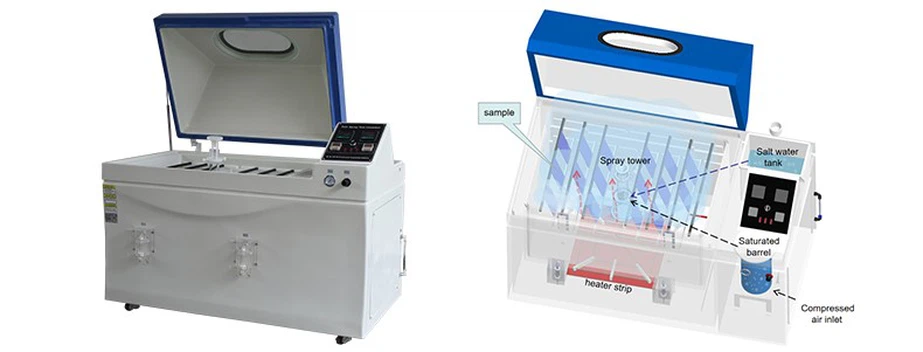
First, a precision spray system atomizes a 5% NaCl solution through corrosion-resistant quartz nozzles at a stable pressure of 83 kPa, generating fine salt mist particles that simulate marine aerosols.
Second, a saturated air preheating system maintains internal chamber temperature at 35 ± 2 °C (NSS standard) while minimizing temperature fluctuation within ±0.5 °C, ensuring stable evaporation and deposition conditions.
Third, an intelligent PID control system with PT-100 sensors continuously adjusts heating and humidification to maintain consistent salt concentration and fog density. This prevents uneven deposition and ensures identical exposure across all test samples.
Together, these systems replicate real marine corrosion mechanisms such as salt crystallization, wet–dry cycling, and chloride penetration under controlled laboratory conditions.
LIB Salt Chamber Testing According to ISO 9227 (NSS Cycle Example)
One of the most widely used standards for marine and salt fog exposure testing is ISO 9227 Neutral Salt Spray (NSS).
1. Standard Requirements
Salt solution: 5% NaCl
pH value: 6.5–7.2
Chamber temperature: 35 ± 2 °C
Spray deposition rate: 1–2 mL/80 cm²/h
Spray pressure: 83 kPa
Continuous exposure duration: 24h to 1000h+ depending on specification
2. Typical Test Cycle
A standard corrosion test cycle includes:
Salt fog exposure phase at 35 °C continuous spray
Constant deposition monitoring (1–2 mL/80 cm²/h)
Optional dry or inspection intervals depending on product standard
Long-term exposure from 24h, 96h, 240h, up to 1000h
This cycle simulates years of coastal corrosion in a shortened laboratory timeframe.
3. LIB Chamber Advantages
|
|
|
||||||||
| Name | Salt Spray Chamber | ||||||||
|
Model |
SC-010 |
SC-016 |
SC-020 |
||||||
|
Internal dimensions (mm) |
800*1450*680 |
1000*1600*800 |
1000*2000*900 |
||||||
|
Overall dimensions (mm) |
1400*2500*1720 |
1600*2650*1840 |
1600*3050*1940 |
||||||
|
780 |
1280 |
1800 |
|||||||
|
780 |
|||||||||
|
Interior Volume (L) |
780 |
||||||||
|
Temperature Range |
+10 ℃ ~ +90 ℃ |
||||||||
|
Temperature Fluctuation |
± 0.5 ℃ |
||||||||
|
Temperature Deviation |
± 2.0 ℃ |
||||||||
|
Humidity Range |
30% ~ 98% RH |
||||||||
|
Humidity Deviation |
+ 2%, - 3% |
||||||||
|
Salt Fog Deposition |
1~2ml / 80cm2 · h |
||||||||
|
Air Preheating |
Saturated air barrel (31Liter) |
||||||||
|
Spraying System |
Atomizer tower and Spray nozzles |
||||||||
|
Salt Fog Collected |
Fog collector and fog measure cylinder |
||||||||
|
Sealing |
Pneumatic seal |
||||||||
|
Controller |
Programmable color LCD touch screen controller, Ethernet connection, PC Link, USB |
||||||||
|
View Window Size(mm) |
800*300 |
||||||||
|
Material |
Glass fiber reinforced plastics |
||||||||
|
Standard Configuration |
8 round bars |
||||||||
|
Standard |
IEC60068-2-52, IEC61701-2,ASTM G85,ISO 7253, ASTM B117, ISO9227 |
||||||||
|
Environmental Conditional |
5℃~+35 ℃ ≤85% RH |
||||||||


|
salt spray tower |
cylinder |
spray collector |


1. High Stability Control System
Maintains temperature accuracy of ±0.5 °C and ensures consistent salt fog density across long-duration tests.
2. Uniform Spray Distribution
Quartz nozzles and optimized tower design guarantee even salt deposition across all sample positions.
3. Programmable Test Automation
Supports up to 120 programs with multi-step NSS/AASS/CASS cycles for complex corrosion simulation.
4. Full Data Traceability
Records temperature, pH, spray time, and deposition rate in real time for ISO/quality audit compliance.
5. Industrial-Grade Durability Design
Corrosion-resistant structure and safety protection systems ensure stable operation in continuous testing environments.
FAQs on LIB Salt Chamber
Q1: How is the equipment delivered and installed?
LIB provides global shipping with reinforced packaging. For most regions, delivery time is 7–15 days for spare parts support, and installation guidance is provided via remote video or on-site service depending on project requirements.
Q2: What after-sales service is included?
Each chamber comes with a 3-year warranty and lifetime technical support. If remote troubleshooting is insufficient, LIB can dispatch replacement components or a full unit depending on the issue.
Q3: Can the chamber simulate different marine environments?
Yes. The system supports NSS, AASS, and CASS test modes, allowing simulation of mild coastal air, acidic industrial marine conditions, and severe offshore corrosion environments.
Q4: Is data export and remote monitoring available?
Yes. The chamber includes USB and Ethernet interfaces for real-time data logging, export, and integration with laboratory management systems.
Q5: What industries commonly use this equipment?
Automotive, marine engineering, aerospace, electronics, coatings, and construction materials industries all rely on salt fog exposure testing for durability validation.
Contact LIB Industry to learn how our Salt Fog Corrosion Test Chamber can improve your product reliability and accelerate your corrosion testing process.